Why Are My No Bake Cookies Oily?
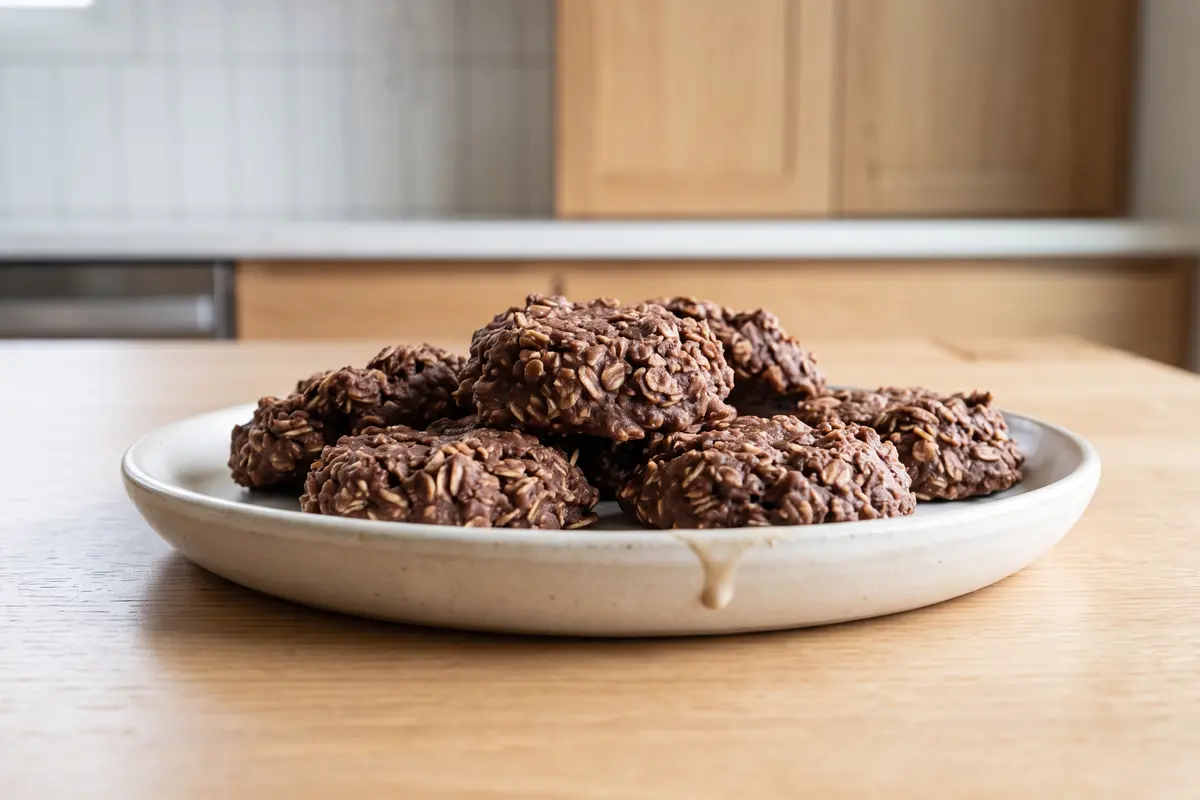
Why are my no bake cookies oily? Excess butter, overheating, or an unbalanced ingredient ratio can cause greasy cookies that leave puddles on your baking sheet. Learn what causes oily no bake cookies and how to fix the problem for smooth, fudgy treats every time.
Within ten minutes, my beautiful cookies were sitting in their own oily halos, and I had no idea what I’d done wrong. Turns out, oily no bake cookies aren’t about bad ingredients or bad luck.
They happen when the fat in the peanut butter or butter separates out instead of staying blended into the sugar mixture. The good news? Once you know the three main causes, you can fix the batch in front of you and nail it every single time after that.
Let me walk you through exactly what went wrong, how to rescue those greasy cookies, and the one timing trick most recipes never mention that keeps the fat locked in where it belongs.
- Oily no bake cookies are caused by under-boiling (less than 1 minute full rolling boil), natural peanut butter with separated oil, or overmixing after the boil.
- A full rolling boil for 1 minute is essential: the sugar needs that heat and time to form a stable structure that holds the fats in suspension as the cookies cool.
- Natural peanut butter must be stirred completely before measuring, or the oil layer ends up in your cookies instead of being evenly distributed.
- You can often rescue an oily batch by refrigerating it for 30 minutes to firm up, then blotting the surface oil with a paper towel.
- Always use a candy thermometer or timer, and stick with regular (not natural) peanut butter for the most foolproof results.
Table of Contents
Why Are My No Bake Cookies Oily?
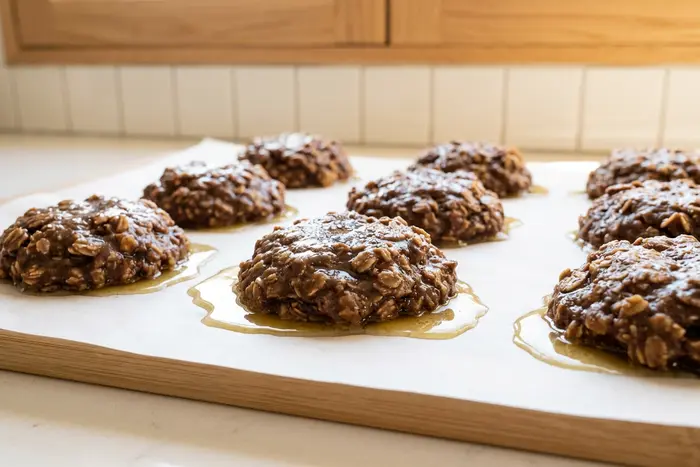
Oily no bake cookies happen when the fats in the butter and peanut butter separate out of the sugar mixture instead of staying emulsified. This is almost always caused by under-boiling the sugar mixture (less than 1 minute at a full rolling boil), using natural peanut butter with a layer of separated oil on top, or overmixing the dough after you take it off the heat.
When the sugar doesn’t get hot enough or stay at a boil long enough, it can’t form the stable structure that holds all the fats together as the cookies cool.
The sugar in no bake cookies acts like the glue that binds everything. When you boil sugar, butter, milk, and cocoa together, the heat dissolves the sugar completely and lets it grab onto the fats. If you pull the pot off the stove too soon, the sugar never gets a chance to do its job, and the fats just sit there loose, waiting to leak out.
What Went Wrong? Match Your Cookies to the Cause
| What You See | Likely Cause | Quick Fix |
|---|---|---|
| Shiny oil puddles around each cookie within 10 minutes of scooping | Mixture didn’t boil long enough (under 1 minute full rolling boil) | Chill cookies 30 minutes, blot oil, store cold |
| Greasy film on top of cookies, especially in the center | Natural peanut butter with separated oil mixed in | Blot surface oil; next time stir PB jar completely or use regular |
| Cookies look dry and crumbly but leave an oily residue on your fingers | Overmixed after adding peanut butter and oats, breaking the emulsion | Press cookies into bars, chill, and slice; the cold firms up loose fats |
Use this table to figure out which mistake happened, then jump to that section below for the full fix and prevention steps.
Cause #1: You Didn’t Boil the Mixture Long Enough
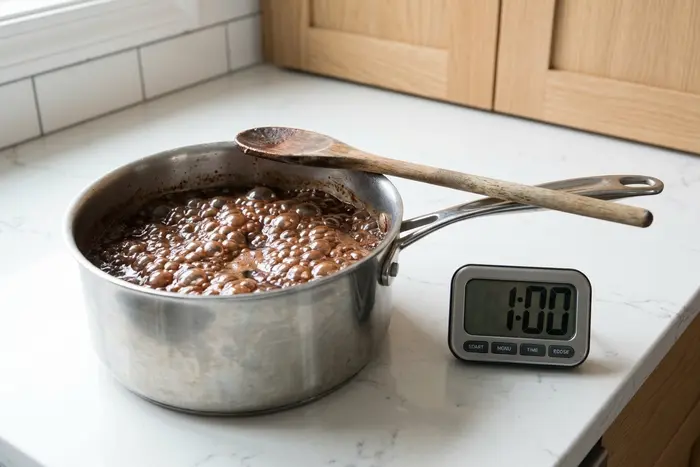
If you didn’t let the sugar mixture boil at a full rolling boil for at least 1 minute, the sugar never got hot enough to dissolve completely and bind the fats. The result is a loose, greasy mixture that can’t hold together as it cools.
Most recipes say “bring to a boil,” but they don’t explain that you need big bubbles covering the entire surface of the pan, not just a few bubbles around the edges.
A full rolling boil means the bubbles are so vigorous they don’t stop when you stir. Set a timer the moment you see that happen, and let it go for 1 full minute. If you pull the pan off even 15 seconds early, the sugar mixture won’t reach the right temperature (around 230°F to 235°F, or 110°C to 113°C), and the fats will separate as the cookies cool.
The fix for next time: Use a timer and a candy thermometer if you have one. Watch for the boil to cover the whole pan, start your timer, and don’t stop stirring. If you’re at high altitude, you may need to boil for 1 minute 15 seconds to 1 minute 30 seconds, because water boils at a lower temperature up there and the sugar needs the extra time to concentrate.
Cause #2: You Used Natural Peanut Butter Without Stirring It First
Natural peanut butter separates in the jar: the oil floats to the top, and the thick peanut paste sinks to the bottom. If you scoop from the top without stirring the whole jar together first, you’re adding almost pure oil to your cookies. That oil has nothing to bind to, so it leaks right back out as the cookies set.
Even if you did stir, natural peanut butter has a higher oil content and a looser texture than regular peanut butter, which makes it harder for the sugar to hold everything in suspension. Regular peanut butter (the kind with added stabilizers, like Jif or Skippy) stays emulsified on its own, so it’s much more forgiving in no bake cookies.
The fix for next time: If you love natural peanut butter, stir the entire jar completely before you measure, and make absolutely sure your sugar mixture boils for the full minute. For foolproof results, switch to regular peanut butter. It’s not about the flavor; it’s about the texture. The stabilizers in regular peanut butter do exactly what you need them to do: keep the oil from separating.
Cause #3: You Overmixed After Adding the Peanut Butter and Oats
Once you take the pot off the heat and stir in the peanut butter, vanilla, and oats, you want to mix just until everything is coated and combined. If you keep stirring and stirring, especially if the mixture has started to cool, you can break the emulsion.
The fats that were nicely suspended in the hot sugar start to separate out, and you end up with greasy cookies even though you did everything else right.
This is most common when people try to fix a mixture that looks too dry by stirring harder or longer. The more you work it, the more the fats break free. No bake cookie dough should look a little rough and mounded when you scoop it, not smooth and shiny.
The fix for next time: Stir just until the oats are evenly coated and no dry pockets remain, then stop. If the mixture looks too thick, the problem was likely the boil (not enough time or heat), and more stirring won’t help. Scoop the cookies immediately while the mixture is still warm. The faster you get them onto the parchment, the better they’ll hold together.
Can You Fix No Bake Cookies That Are Already Oily?
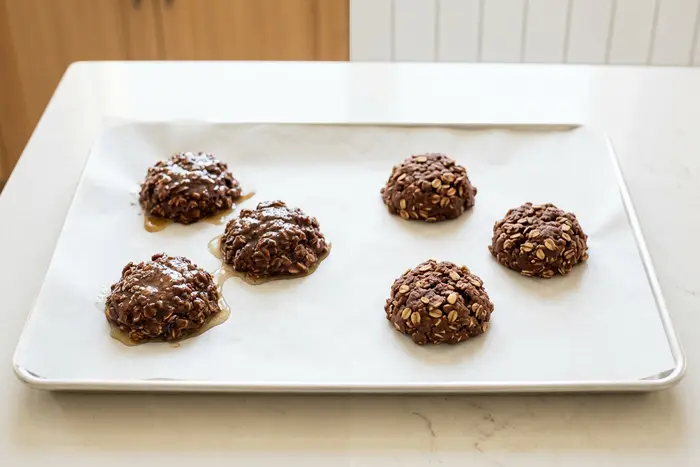
Yes, you can usually salvage an oily batch, though they won’t be quite as perfect as a batch made right the first time. Refrigerate the cookies for 30 minutes to firm up the fats, then gently blot the surface oil with a paper towel. Press lightly; you’re not trying to squish the cookies, just soak up the grease. Store the cookies in the fridge in a single layer, and eat them cold.
The chill keeps the fats from separating again.
If the cookies are so greasy they’re falling apart, press the whole batch into a parchment-lined 8×8 inch pan, chill until firm, then cut into bars. You’ll lose the classic mounded shape, but the texture will be much better, and they’ll taste just fine. Think of them as no bake cookie bars instead.
If the cookies never set at all and are just a greasy puddle, there’s not much you can do to save them as cookies. Crumble the mixture over ice cream, stir it into yogurt, or press it into a pie crust as a crunchy bottom layer. It’s not what you planned, but it’s better than throwing it out.
How to Prevent Oily No Bake Cookies Next Time
To prevent oily no bake cookies, always boil the sugar mixture at a full rolling boil for 1 full minute, use regular peanut butter instead of natural, and stir just until combined after adding the peanut butter and oats. These three habits eliminate almost every cause of greasy cookies.
If you want to be extra sure, use a candy thermometer and pull the pot off the heat when it hits 230°F to 235°F (110°C to 113°C).
- Set a timer the moment you see big bubbles covering the entire surface of the pan, and don’t stop the boil early even if it looks done.
- If you’re using natural peanut butter, stir the entire jar completely before measuring, and consider boiling for an extra 15 seconds to give the sugar more time to bind the extra oil.
- Measure your ingredients before you start: once the mixture is boiling, you need to work fast, and stopping to measure peanut butter or oats gives the pot time to cool.
- Scoop the cookies onto parchment as soon as you finish stirring in the oats. The mixture sets up quickly, and waiting even a minute or two can make it harder to scoop and more likely to separate.
- Use a medium saucepan, not a small one. A wider surface area helps the mixture boil evenly and makes it easier to see when you’ve hit a true rolling boil.
Once you nail the boil and the peanut butter, no bake cookies are one of the easiest treats you can make. I keep a batch in the fridge all the time now, and I haven’t had a greasy one in years.
If you want the full walkthrough with exact ingredient amounts and step-by-step photos, check out my classic no bake cookies recipe. It covers every detail, from the type of cocoa to the best way to tell when the boil is ready. And if you’re troubleshooting other no bake cookie problems (like cookies that won’t set or stay too soft), the no bake cookie tips & troubleshooting guide has you covered.
Frequently Asked Questions
Can I use natural peanut butter in no bake cookies without them getting oily?
Yes, but you must stir the entire jar of natural peanut butter completely before measuring, and boil the sugar mixture for the full 1 minute (or even 15 seconds longer) to give the sugar enough time to bind the extra oil. Regular peanut butter is more foolproof because it contains stabilizers that keep the oil from separating, so if you’ve had trouble with greasy cookies before, switching to regular peanut butter is the easiest fix.
How long should I boil no bake cookies to avoid an oily texture?
Boil the sugar, butter, milk, and cocoa mixture at a full rolling boil for exactly 1 minute. A full rolling boil means big bubbles covering the entire surface of the pan that don’t stop when you stir. Start your timer only when you see that vigorous boil, and don’t pull the pot off the heat early. Under-boiling is the most common cause of oily no bake cookies, because the sugar never gets hot enough to hold the fats in suspension as the cookies cool.
Why do my no bake cookies look dry but still feel greasy?
This happens when you overmix the dough after adding the peanut butter and oats, which breaks the emulsion and causes the fats to separate even though the sugar structure is intact. The cookies look crumbly because the sugar set, but the fats leaked out and coat your fingers when you touch them. Next time, stir just until the oats are evenly coated, then stop and scoop immediately.
Can I fix no bake cookies that are sitting in pools of oil?
Refrigerate the cookies for 30 minutes to firm them up, then gently blot the surface oil with a paper towel. Store them in the fridge and eat them cold; the chill keeps the fats from separating again. If they’re too greasy to hold their shape, press the batch into a pan, chill until firm, and cut into bars instead. They won’t be perfect, but they’ll taste fine and have a much better texture than leaving them at room temperature.
Do no bake cookies get oily if you don’t refrigerate them?
No bake cookies can get slightly oily at warm room temperature because heat softens the fats and makes them more likely to separate, but the main cause of greasy cookies is under-boiling or using separated natural peanut butter, not skipping the fridge. If your cookies were made correctly, they’ll hold together fine at cool room temperature (under 70°F or 21°C). In hot weather or if you’re worried about texture, storing them in the fridge is a good idea.