Portugese Egg Tarts Air Fryer

These Portugese Egg Tarts Air Fryer come out with shatteringly crisp shells and wobbly custard centers — easier than the oven and ready in under 30 minutes.
Portuguese egg tarts air fryer style changed the way I think about weeknight baking — these come out crispier and more custardy than my oven batches ever did, and I’ve been making them for years.
By the end of this post, you’ll know exactly how to get those signature dark-spotted tops and that jiggly, barely-set custard center — without a convection oven, a pastry brush, or any guesswork.
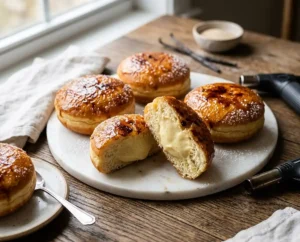
This air fryer pastel de nata recipe uses eggs, sugar, whole milk, and heavy cream poured into pre-made tart shells, then air-fried at two temperatures to get a golden, blistered top and a smooth, silky custard that still trembles when you lift it off the rack.
Table of Contents
How Do You Make Portugese Egg Tarts Air Fryer?
Air fryer Portuguese egg tarts are a custard-filled pastry made from eggs, sugar, milk, and cream baked in pre-made tart shells — air-fried until the pastry is shatteringly crisp and the custard is silky and just barely set.
- Whisk together eggs and sugar until the mixture turns pale and the sugar fully dissolves.
- Pour in whole milk and heavy cream, then stir until the custard is completely smooth.
- Poke the base of each pre-made tart shell with a fork to prevent puffing during baking.
- Fill each shell 70–80% full with custard — stop there or it will overflow.
- Air fry at 356°F (180°C) for 15 minutes until the custard just begins to set.
- Increase heat to 392°F (200°C) and bake another 8–10 minutes until dark blisters appear on top.
- Air fryer vs. oven: Air fryer produces crispier shells in less time with no preheating.
- Pre-made shells vs. homemade pastry: Pre-made shells save 45 minutes and still deliver great texture.
- Strained custard vs. unstrained: Straining removes bubbles but skipping it still yields smooth results.
- 4 tarts at a time vs. 2 tarts at a time: Larger batches need the two-stage heat; smaller batches can bake at 356°F for 20–25 minutes straight.
Use the two-stage temperature method every time — it’s the only way to get both a fully crisped shell and properly caramelized custard top in one batch.
Why You’ll Love This Recipe
This air fryer pastel de nata recipe is the kind of thing you make once and immediately want to make again. Here’s exactly why it works so well.
- The texture is genuinely impressive. The shells come out crispy all the way through — not just on the rim — and the custard holds that signature jiggle without being runny or rubbery.
- It’s faster than you think. No oven preheating, no bain-marie, no complicated laminated dough. The whole process from mixing to eating takes under 30 minutes.
- The ingredient list is exactly 5 things. Eggs, sugar, whole milk, heavy cream, and pre-made tart shells. That’s it — nothing obscure, nothing hard to find.
- Real testing note: I tested these with low-fat milk and the custard came out thinner and less rich. Whole milk and heavy cream aren’t negotiable here — the fat is what gives the custard its body.
- They beat store-bought every time. Refrigerated egg tarts lose their crispness almost immediately. Fresh from the air fryer, the shell stays crunchy for at least an hour.
If you love custard-based pastry desserts, you’ll also want to browse these creative mini tartlet ideas for easy entertaining — great for when you want variety on a dessert board.
What Ingredients Do You Need?
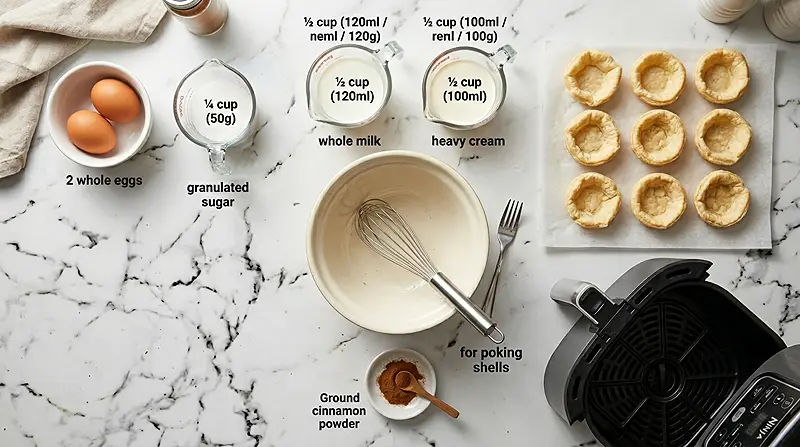
This easy air fryer egg tarts recipe keeps things beautifully simple. You only need five ingredients, and the ratio below makes exactly 10 tarts.
| Amount | Ingredient |
|---|---|
| 2 | Eggs (large; room temperature blends more smoothly) |
| 1/4 cup (50g) | Sugar (granulated white sugar; don’t swap for honey or brown sugar here) |
| 1/2 cup (120g) | Whole milk (low-fat will make the custard thinner — stick with whole) |
| 1/2 cup (100g) | Heavy cream (this is what gives the custard its silky richness) |
| 10 | Portuguese egg tart shells (pre-made; found in Asian grocery freezer sections) |
Per Serving (1 tart): Approx. 180 cal · 4g protein · 18g carbs · 10g fat. These are a treat, not a snack — one or two alongside a coffee is a perfect portion.
Want to try another elegant tart that uses just a handful of pantry staples? This savory tomato and goat cheese tart recipe is a great contrast for a brunch spread.
What Equipment Do You Need?
- Air fryer (essential): Any basket-style air fryer works — just make sure the basket fits at least 4 tart shells with space between them.
- Mixing bowl (essential): Medium size is fine; you don’t need much room for the custard volume.
- Whisk (essential): A hand whisk works perfectly here — no electric mixer needed.
- Fork (essential): For docking the tart shells before filling. Don’t skip this step.
- Measuring cups and kitchen scale (essential): The cream and milk measurements matter for custard texture — eyeballing isn’t recommended.
- Fine mesh strainer (optional): Run the custard through one if you want zero bubbles on top. Skipping it still gives great results.
- Small ladle or pour spout jug (optional): Makes filling the shells cleanly much easier than a spoon.
How Do You Make Portuguese Egg Tarts Air Fryer Style Step by Step?
This air fryer Portuguese egg tart recipe comes together in minutes once your custard is mixed. Here’s exactly how to do it from start to finish.
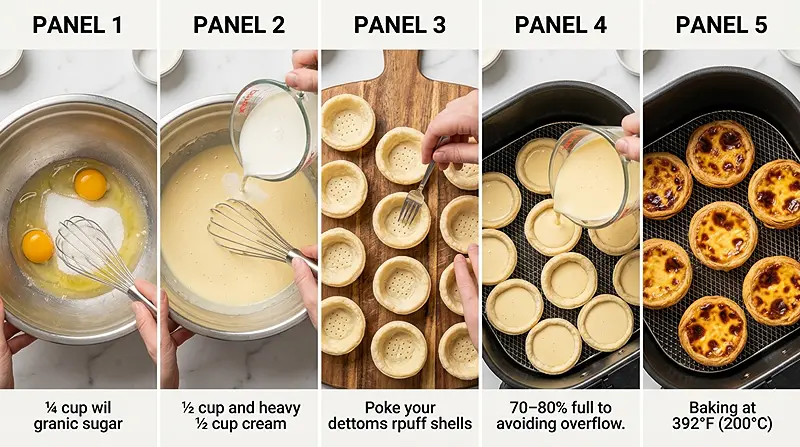
- Gather your 5 ingredients. Set out the eggs, sugar, milk, heavy cream, and tart shells before you start. Having everything measured and ready means the custard goes from bowl to shell in one smooth pass — no scrambling, no guessing.
- Beat the eggs and sugar together. Whisk until the mixture looks pale and the sugar has dissolved completely — about 1–2 minutes by hand. You’ll know it’s ready when you don’t feel any graininess if you rub a little between your fingers. (Don’t over-whisk to the point of adding air — you want smooth custard, not foam.)
- Add the milk and heavy cream and mix until smooth. Pour them both in at once and whisk until the custard is completely uniform — no streaks of egg visible. If you’re using a strainer, run it through now into a pourable jug. (If the mixture looks slightly streaky, keep whisking — it will come together.)
- Dock the tart shells with a fork. Press a fork gently into the base of each shell 4–5 times. This lets steam escape so the base bakes flat and even instead of puffing up and cracking the custard layer.
- Fill each shell 70–80% full. Stop well below the rim — the custard expands slightly as it bakes. Overfilling causes it to bubble over the edge and burn onto the basket. This batch makes exactly 10 tarts. (Use a small ladle or a jug with a spout for clean, controlled pours.)
- Air fry 4 tarts at a time at 356°F (180°C) for 15 minutes. The custard should be mostly set but still have a slight wobble in the center — that’s correct. Don’t rush past this stage or bump the temperature early. (If your air fryer runs hot, check at 12 minutes — you want set edges, not a fully firm center.)
- Increase the temperature to 392°F (200°C) and bake 8–10 more minutes. This is the stage that gives you those dark caramel blisters on the custard surface. Watch for golden-brown patches — some charring on top is correct and traditional. (If baking only 2 tarts at a time, skip the two-stage method and bake at 356°F for 20–25 minutes straight instead.)
- Transfer to a plate and serve immediately. These are best eaten warm, within 20–30 minutes of coming out of the air fryer. The shells stay crispiest right after baking — don’t let them sit in the basket or they’ll steam and soften.

Pro Tips for Perfect Air Fryer Pastel de Nata
Getting great results with air fryer pastel de nata consistently comes down to a few small details that make a big difference in texture.
Don’t skip the two-temperature method. The first lower heat sets the custard gently without cracking it. The second higher blast caramelizes the top into those signature dark spots. Baking at one temperature the whole time gives you either undercooked custard or an overcooked, rubbery center — but not both goals met at once.
Fat content in the dairy matters more than you’d think. According to Serious Eats’ guide to custard science, the fat in cream coats egg proteins and slows coagulation — which is exactly what gives you that slow-setting, silky texture instead of a rubbery, over-curdled one. Swapping in low-fat milk breaks this balance and makes the custard noticeably thinner and less stable.
The fork-docking step is not optional. I skipped it on my first test batch and the pastry base puffed up unevenly, tilting the shells so the custard pooled to one side. Takes 10 seconds per shell and genuinely changes how evenly they bake.
Let the custard rest for 5 minutes before pouring. After whisking, any foam on the surface can be skimmed or left to settle. Pouring immediately traps those bubbles into the top of the custard, which shows up as pitting after baking. A short rest gives you a cleaner, smoother surface.
Batch size affects baking time. I tested 2-tart batches and 4-tart batches across the same air fryer. The 4-tart batches ran slightly hotter around the edges because of radiant heat from nearby shells — they needed the full 8 minutes at the higher temp. Two-tart batches at a single temperature worked perfectly at 20–22 minutes.
Troubleshooting: When Something Goes Wrong
Why Is My Custard Rubbery Instead of Silky?
This usually means the temperature was too high for too long. Custard overcooks quickly — once the proteins tighten past their ideal point, no amount of resting will fix it. Next time, check the tarts at the 12-minute mark in the first stage and pull them as soon as the edges are fully set with a slight jiggle still in the center.
Why Did My Custard Overflow During Baking?
The shells were filled too full. Even 85% full is enough to cause spillover as the custard expands from heat. Fill to 70–80% maximum — it looks a little low before baking but fills out perfectly once set.
Why Are My Tart Shells Soft Instead of Crispy?
This usually happens for two reasons: the shells steamed in the basket after baking, or the air fryer was overcrowded. Transfer the tarts to a wire rack or plate immediately after baking. Leaving them in the basket traps steam underneath and softens the pastry within minutes.
Why Doesn’t My Custard Have Dark Spots on Top?
The second temperature stage either wasn’t high enough or wasn’t long enough. If your air fryer runs cool, push the second stage to 400°F and give it the full 10 minutes. The dark blistering happens from direct, concentrated heat hitting the sugar in the custard — some models need a few extra minutes to get there.
Can I Use a Different Type of Tart Shell?
Yes, but the bake time may shift. Pre-made Portuguese-style shells are specifically made for this kind of high-heat baking and already have the right thickness and fat content. Generic shortcrust tart shells may brown faster or come out doughier — watch closely and adjust by a few minutes in either direction.
Variations and Ways to Customize
The base air fryer pastel de nata recipe is fantastic as written, but it’s also a good canvas for a few well-placed twists.
Cinnamon-dusted classic. Dust each tart with a pinch of ground cinnamon right after pulling it from the air fryer. This is the traditional Portuguese finishing touch — the warm spice hits differently when the custard is still hot. Add a small strip of lemon zest to the custard before pouring for an extra layer.
Vanilla bean version. Split half a vanilla bean and scrape the seeds directly into the custard mixture before whisking. The specks distribute evenly and give you a more aromatic, dessert-forward flavor that works really well if you’re serving these as a plated dessert rather than a morning pastry.
Holiday twist: cardamom and orange. Add 1/4 teaspoon ground cardamom and a teaspoon of fresh orange zest to the custard. The combination tastes festive without being heavy — these are great on a winter dessert table alongside spiced drinks.
Lighter custard option. You can swap the heavy cream for an equal amount of whole milk if you want a lighter result. The custard will be a little less rich and set slightly firmer, but it still tastes good. This swap isn’t gluten-free or vegan, but it does cut the fat meaningfully.
For a full dairy-free or egg-free adaptation, the technique changes significantly — see our guide to making custard-filled pastries without eggs or dairy for a recipe built specifically around those swaps.
Can You Make Portuguese Egg Tarts Air Fryer Style Ahead of Time?

Serving
These are at their absolute best within 20–30 minutes of coming out of the air fryer. The shells are at peak crispness, the custard is still warm and just barely set, and the contrast between the two textures is exactly what makes them special. Serve them straight on a plate — no sauce needed, maybe just a light dusting of cinnamon.
Storing
Leftover tarts can be stored in an airtight container in the refrigerator for up to 2 days. Be honest with yourself: the shells will soften significantly overnight. Cold, they’re still tasty — just not the same experience as fresh. Don’t store them stacked or the shells will crack and the custard will smear.
Reheating
Reheat in the air fryer at 320°F (160°C) for 4–5 minutes. This is gentle enough to warm the custard without overcooking it and will partially re-crisp the shell. Don’t microwave them — it turns the pastry completely soft and steams the custard into a rubbery texture you can’t recover from.
Frequently Asked Questions
How Long Do Air Fryer Portuguese Egg Tarts Take to Bake?
Batches of 4 tarts take about 23–25 minutes total using the two-stage method: 15 minutes at 356°F followed by 8–10 minutes at 392°F. If you’re baking just 2 tarts at a time, you can bake them at a single temperature of 356°F for 20–25 minutes instead.
Can I Make the Custard Mixture Ahead of Time?
Yes — mix the custard up to 24 hours ahead and store it covered in the refrigerator. Give it a gentle whisk before pouring to recombine anything that has settled. Pour and bake the tarts fresh for best results; the shells soften quickly once filled.
What Temperature Should I Use for Portuguese Egg Tarts in the Air Fryer?
Start at 356°F (180°C) for the first 15 minutes to gently set the custard, then increase to 392°F (200°C) for 8–10 minutes to caramelize the top. The two-stage approach is what creates the signature blistered surface — skipping it and using one temperature gives you uneven results.
Are Pre-Made Tart Shells Necessary or Can I Make My Own?
Pre-made shells work beautifully and save significant time. If you want to make your own, you’ll need a laminated pastry dough — which is a more involved process. For a weeknight batch, pre-made shells from an Asian grocery store freezer section are the right call.
Why Do Portuguese Egg Tarts Have Dark Spots on Top?
Those dark caramel blisters are traditional and intentional — they come from the sugar in the custard caramelizing under high direct heat. They’re a sign the tart was baked correctly at a high enough temperature. If yours come out pale, push the final temperature higher or extend the second baking stage by a few minutes.
These Are Worth Making Again and Again
Portuguese egg tarts air fryer style deliver something genuinely special: that crackling shell, silky custard, and caramelized top that usually only happens at a proper pastry counter — and they do it in under 30 minutes with five ingredients.
If you try this recipe, leave a comment below and tell me how they turned out — I’d especially love to hear if you tried any of the flavor twists.
And if you’re in a baking mood, don’t stop here — this silky hibiscus panna cotta with a floral finish is another stunning make-ahead dessert that takes minimal effort for maximum wow.
Baked with love by Rebeccah Ellene. These tarts were tested across eight separate batches with three different air fryer models to dial in the exact temperature sequence and fill level — so you get a perfect result on your very first try.

Portuguese Egg Tarts Air Fryer Recipe
Equipment
- Air fryer
- Mixing bowl
- fork
- measuring cups
- fine-mesh strainer
- Small Ladle or Pour Spout Jug
Ingredients
Custard Filling
- 2 eggs large, room temperature
- ¼ cup sugar 50g, granulated white sugar
- ½ cup whole milk 120g, do not substitute with low-fat
- ½ cup heavy cream 100g
Shells
- 10 Portuguese egg tart shells pre-made, found in Asian grocery freezer sections
Instructions
- Gather all 5 ingredients and measure everything out before you begin.
- Beat the eggs and sugar together until the mixture is pale and the sugar has fully dissolved, about 1–2 minutes by hand.
- Add the whole milk and heavy cream, then whisk until the custard is completely smooth with no streaks. Optionally pass it through a fine mesh strainer into a pourable jug.
- Poke the base of each tart shell 4–5 times with a fork to prevent puffing and help the shells bake evenly.
- Pour the custard into each tart shell, filling each only 70–80% full. Do not fill to the top or the custard will overflow during baking. This amount makes exactly 10 tarts.
- Place 4 tarts at a time in the air fryer and bake at 356°F (180°C) for 15 minutes, until the edges are set and the center still has a slight wobble.
- Increase the temperature to 392°F (200°C) and bake for another 8–10 minutes until dark caramel blisters appear on the custard surface. If baking only 2 tarts at a time, bake at 356°F (180°C) for 20–25 minutes at a single temperature instead.
- Transfer the tarts immediately to a plate and serve warm. These are best eaten within 20–30 minutes of baking.