Matcha Basque Cheesecake
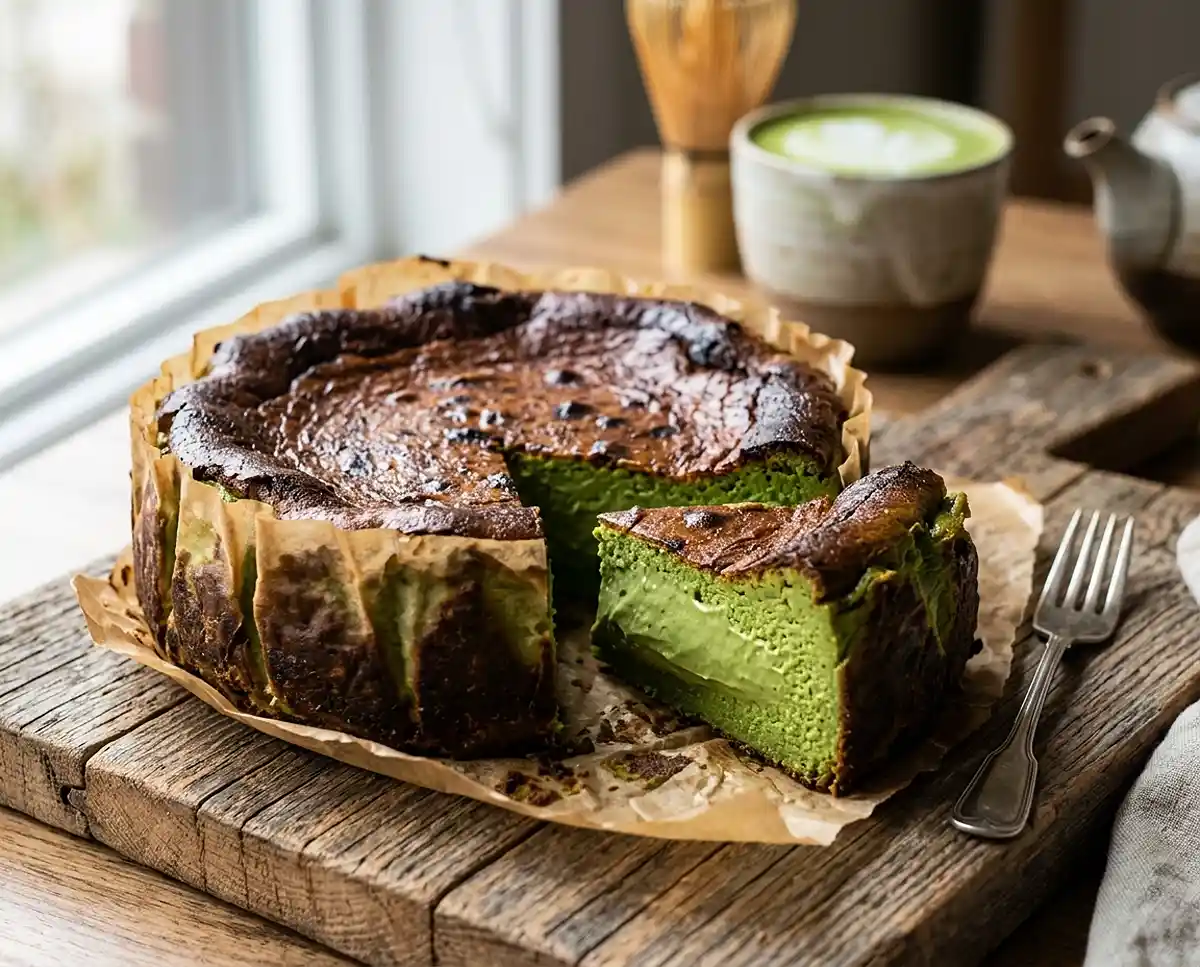
This matcha basque cheesecake has a scorched top, a custardy center, and a green tea depth that’ll stop you mid-bite. One bowl, no water bath — get the full recipe now.
Matcha basque cheesecake is the one bake I’ve made more than anything else this year — and I still get a little giddy every time I slice into it.
Read this and you’ll know exactly how to nail the bake: the right oven temp, the cooling trick that makes or breaks the texture, and why your matcha choice matters more than you think.
This matcha basque cheesecake combines cream cheese, sugar, ceremonial-grade matcha, eggs, and heavy cream, baked at a scorching 240°C until the top is beautifully charred and the center is still trembling — the result is a custardy, bittersweet, melt-on-your-tongue slice that’s equal parts Japanese tea ceremony and Spanish pintxos bar.
I first tasted a version of this at a tiny dessert shop in Melbourne, and I spent the next three weekends trying to crack it at home. Batch four was when I finally got it right — and the secret was in the cooling, not the baking.
Table of Contents
How Do You Make a Matcha Basque Cheesecake at Home?
A matcha basque cheesecake is a Japanese-inspired take on the classic Spanish burnt cheesecake — made from cream cheese, eggs, heavy cream, and matcha powder, baked at high heat until the top chars and the center stays soft and custard-like.
- Preheat your oven to 240°C / 465°F and line a 6-inch cake tin with crinkled baking paper.
- Beat the cream cheese until silky-smooth, then add the sugar and mix until fully combined.
- Add the matcha powder, cornstarch, and vanilla extract, beating until the batter is lump-free and evenly green.
- Whisk in the eggs one at a time, then pour in the heavy cream and whisk until the batter is smooth and pourable.
- Bake for 25 minutes until the top is deeply bronzed and the center still has a visible wobble.
- Crack the oven door, rest the cake for 10 minutes, then refrigerate overnight before slicing.
- Matcha vs. no matcha: Matcha adds earthy bitterness that balances the rich cream cheese.
- Baked vs. no-bake cheesecake: Baked gives a custardy, mousse-like center; no-bake sets firmer and lighter.
- 6-inch tin vs. 8-inch tin: Smaller tin means a taller cake with a deeper, creamier center.
- Overnight chill vs. 4-hour chill: Overnight gives a firmer, cleaner slice; 4 hours works but the center is softer.
- Ceremonial matcha vs. culinary matcha: Ceremonial grade gives a brighter, more vibrant green and less bitterness.
Use ceremonial-grade matcha, bake at full heat until the top is genuinely dark, and refrigerate overnight — that combination gives you the custardy center and complex flavor this recipe is known for.
Why You’ll Love This Matcha Basque Cheesecake
This green tea basque cheesecake hits a flavor note that no other dessert quite reaches — deeply savory-sweet, a little bitter, and impossibly rich all at once.
- The texture is unlike any other cheesecake. The high heat and short bake time create a center that’s somewhere between a custard and a mousse — dense but not heavy, smooth but not rubbery.
- It’s genuinely easy. No water bath, no stand mixer required, no springform gymnastics. One bowl, a whisk, and a hot oven.
- The matcha flavor comes through properly. I tested this with both culinary and ceremonial grade matcha — ceremonial gives a cleaner, less astringent flavor and a noticeably more vibrant green color throughout the cake.
- It looks dramatic without any effort. That burnt top isn’t a mistake — it’s the whole aesthetic. You don’t have to decorate anything.
- It beats any café slice. Most store-bought or café versions are too dense and under-flavored. Making it at home means you control the matcha intensity and the bake.
If you love the earthy, creamy combination of matcha and cheese, you’ll want to try this no-bake matcha cheesecake that sets in the fridge without an oven — a completely different texture, just as satisfying.
Ingredients
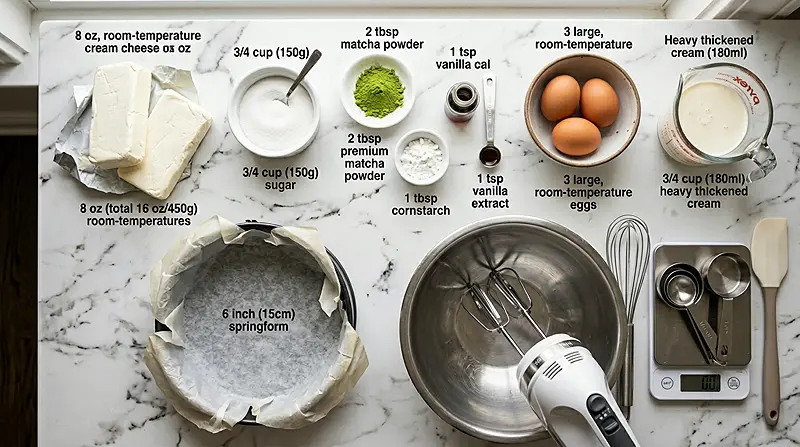
This basque cheesecake matcha recipe uses just seven ingredients — nothing obscure, nothing hard to find. The only thing worth seeking out is a good-quality matcha powder, because it genuinely changes the flavor.
| Amount | Ingredient |
|---|---|
| 16 oz (450 g) | Cream cheese, room temperature (full-fat only — low-fat versions don’t set the same way and the texture suffers) |
| 3/4 cup (150 g) | White sugar |
| 2 tbsp | Matcha powder (ceremonial grade preferred; culinary works but tastes more bitter and bakes duller green) |
| 1 tbsp (7 g) | Cornstarch (helps the center set without turning rubbery — don’t skip it) |
| 1 tsp | Vanilla extract |
| 3 | Large eggs, room temperature (cold eggs can cause lumps and uneven mixing) |
| 3/4 cup (180 ml) | Thickened / heavy cream |
Per Serving (approx. 8 slices): ~340 cal · 6g protein · 22g carbs · 26g fat
This is a rich dessert — a small slice goes a long way. Serve it alongside a bitter green tea or black coffee to balance the sweetness.
What Equipment Do You Need?
- 6-inch / 15 cm round cake tin — essential; a larger tin gives a flatter, less creamy result
- Baking paper / parchment — enough to line the sides and overhang the edges; you’ll use it to lift the cake out
- Large mixing bowl — one is enough for this whole recipe
- Hand mixer or stand mixer — a whisk by hand works but takes more elbow grease to get the cream cheese smooth
- Whisk — for adding the eggs and cream once the base is mixed
- Rubber spatula — to scrape every last bit of batter into the tin
- Fine mesh sieve (optional) — sift the matcha powder before adding it to avoid green lumps in the batter
- Oven thermometer (optional but recommended) — home ovens often run 10–20°C off, and this recipe is temperature-sensitive
How Do You Make Matcha Basque Cheesecake Step by Step?
Making matcha basque cheesecake is a straight-through, no-fuss process — mix everything in one bowl, pour it in, and let the hot oven and the fridge do the work.
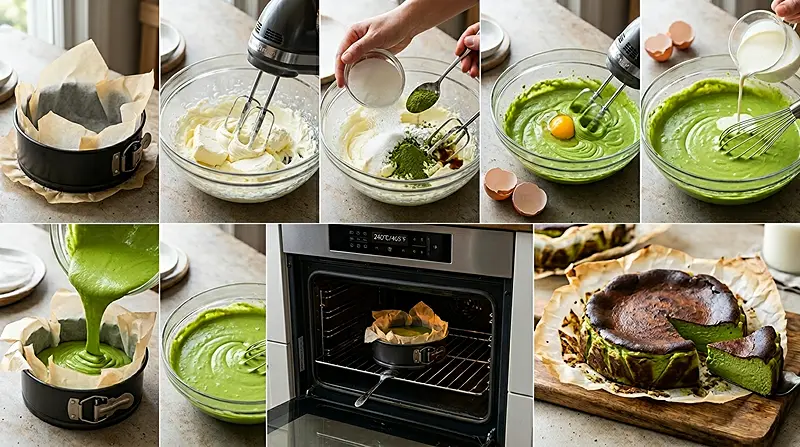
- Preheat the oven to 240°C / 465°F and line your tin. Scrunch the baking paper before pressing it into the tin so it fits the curves without tearing. The overhang gives you a handle to lift the cake out later. Get the oven fully preheated — this cake needs immediate, intense heat from the first second.
- Beat the cream cheese until completely smooth. This step matters more than people think. Any lumps here stay lumps in the finished cake. Beat on medium for a full 2 minutes, scraping down the sides of the bowl. [If your cream cheese is still cold, it won’t smooth out properly — it needs to be genuinely room temperature, not just out of the fridge for 10 minutes.]
- Add the sugar and mix until combined. The mixture will loosen slightly and look glossy. Scrape the bowl again before the next step.
- Add the matcha powder, cornstarch, and vanilla extract and beat until lump-free. Sift the matcha directly into the bowl if you want a smoother batter — matcha clumps easily. Beat until the color is even throughout with no dark green streaks. [If you see green streaks after a minute of mixing, keep going — they’ll disappear.]
- Whisk in the eggs, then add the cream. Switch to a whisk here and add the eggs one at a time, fully incorporating each one before adding the next. Pour in the cream and whisk until the batter is smooth, pourable, and just a little foamy on top. Don’t over-whisk — you’re not trying to add air.
- Pour the batter into the lined tin and bake for 25 minutes. The batter will fill the tin about two-thirds full. Slide it into the center of the hot oven and don’t open the door early. At 25 minutes, the top should be deeply browned — almost burnt-looking — and the center should still wobble visibly when you shake the tin gently. That wobble is correct. [If the top isn’t dark after 25 minutes, your oven is running cool — give it 3–5 more minutes and check again.]
- Open the oven door, wedge in a spoon, and rest the cake for 10 minutes. This slow cool-down prevents the cake from sinking too dramatically or cracking through the top. It’ll deflate slightly — that’s normal and part of the look.
- Transfer to the fridge and chill for a minimum of 4 hours, overnight preferred. Leave the cake in the tin while it chills. The fridge is where it finishes setting — the center transforms from wobbly custard to something dense, velvety, and sliceable. Don’t rush this step.
- Unmould, slice, and serve. Lift the cake out using the baking paper overhang. Peel the paper away from the sides, slice with a warm dry knife, and serve at cool room temperature for the creamiest texture.
Pro Tips for Perfect Matcha Burnt Cheesecake
Getting a great matcha burnt cheesecake comes down to a few specific things — most of which I only figured out after ruining a batch or two.
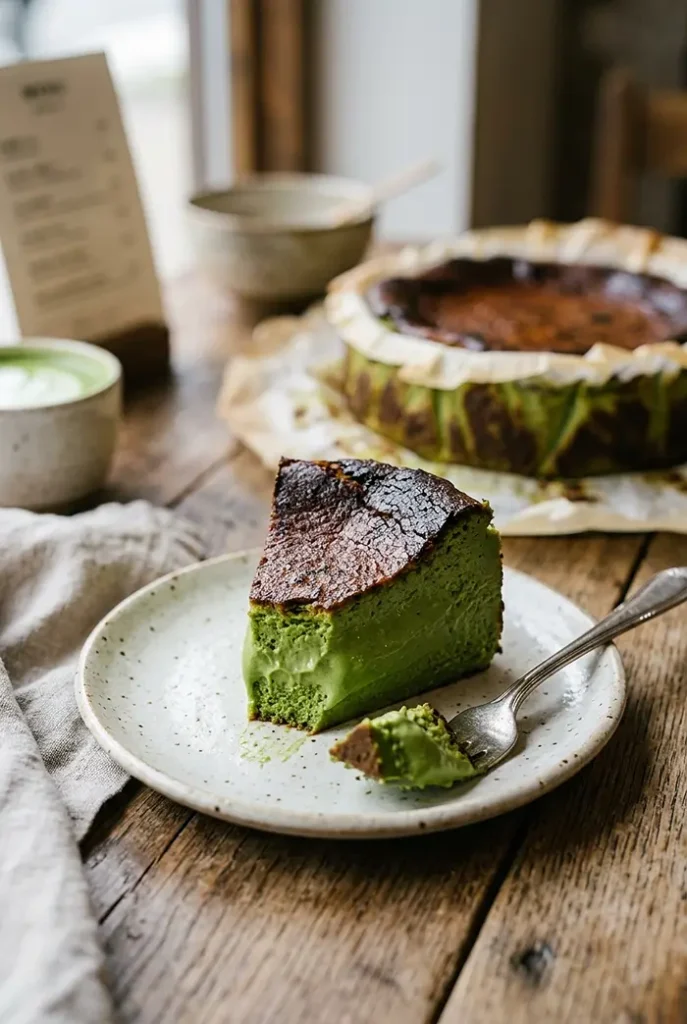
Your matcha grade changes everything. I tested this recipe side by side with culinary and ceremonial grade matcha. Culinary matcha baked into a more khaki-green cake with a sharper, more astringent flavor. Ceremonial grade gave a vivid, forest-green interior and a cleaner, more floral bitterness. If you’re making this to impress, spend the extra few dollars on ceremonial grade.
Room temperature ingredients are non-negotiable. According to King Arthur Baking’s guide on why room temperature ingredients matter in baking, fat molecules in cream cheese and eggs emulsify more smoothly at room temperature, creating a more cohesive, silkier batter. Cold cream cheese doesn’t blend evenly — you end up with tiny dense pockets in the finished cake. Pull everything from the fridge at least an hour before you start.
Trust the wobble, ignore your instincts. The single biggest mistake I made in early batches was pulling the cake when it “looked done” — which meant no wobble, set all the way through, and a dense, slightly grainy texture after chilling. The correct bake has a significant jiggle in the center and a top that genuinely looks almost overdone. If it looks alarming, you’re probably on track.
Overnight chilling changes the texture completely. After 4 hours the cake is sliceable but still quite soft in the center. After 8 hours overnight it firms into that signature dense, velvety, cheesecake-custard texture. If you can wait, wait.
Sift the matcha directly into the bowl. I skipped this step in my first batch and ended up with green lumps through the batter that didn’t fully mix out. A quick sift takes 30 seconds and gives you a smoother, more evenly flavored result.
Troubleshooting: When Something Goes Wrong
Why is the center still completely liquid after baking?
A fully liquid center usually means the oven wasn’t hot enough or the cake didn’t bake long enough. Make sure your oven is fully preheated to 240°C before the cake goes in, and check whether your oven runs cool with a thermometer. Give it 3–5 extra minutes next time.
Why did my cheesecake crack through the top?
A crack usually happens when the cake cools too quickly after baking. The 10-minute rest with the oven door ajar is there to slow that transition. If you skipped it or opened the oven door wide, try a more gradual cool-down next time.
Why does my batter have green lumps in it?
Matcha powder clumps easily, especially when added to cold or stiff cream cheese. Sift the matcha into the bowl before mixing, and make sure your cream cheese is fully softened first. A few extra minutes of beating usually gets the last of the lumps out.
Why is the texture dense and grainy instead of creamy?
This usually means the cake was overbaked — the center set completely in the oven instead of finishing in the fridge. The center should still wobble at the 25-minute mark. Reduce your bake time by 2–3 minutes next time and trust the wobble.
Can I use culinary matcha instead of ceremonial grade?
Yes, it works — but the flavor will be more bitter and the color less vibrant. If culinary matcha is all you have, reduce the amount slightly to 1.5 tbsp to keep the bitterness in balance.
Variations and Ways to Customize
This Japanese matcha basque cheesecake is already pretty perfect as-is, but it takes well to a few tweaks depending on what you’re after.
- Black sesame twist. Replace 1 tablespoon of the matcha with 1 tablespoon of black sesame paste for a nutty, smoky variation that pairs beautifully with the cream cheese. The color shifts from green to a deep charcoal-grey — stunning on a dessert table.
- Hojicha version. Swap the matcha for hojicha powder (roasted green tea) for a warmer, caramel-adjacent flavor with less bitterness. Use the same 2 tablespoon quantity. This is a great option if you find regular matcha too sharp.
- White chocolate swirl. Melt 60g of white chocolate and swirl it into the top of the batter just before baking. It adds a creamy sweetness that softens the matcha bitterness and creates a beautiful marbled top after baking.
- Gluten-free version. This recipe is naturally very low in flour — the cornstarch is already gluten-free, so you don’t need to swap anything. Just confirm your matcha powder is certified gluten-free, as some blends contain additives. For a full guide to baking cheesecake without gluten, see our Dubai chocolate cheesecake with its gluten-free crust notes.
Can You Make Matcha Basque Cheesecake Ahead of Time?
Serving
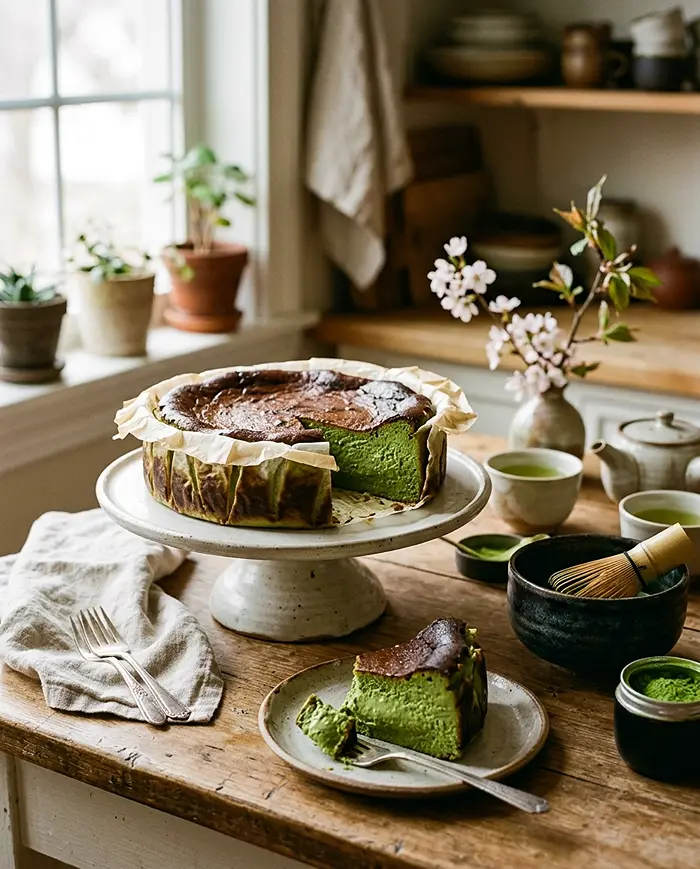
Serve this cake cold or at cool room temperature — straight from the fridge is good, but letting it sit for 15–20 minutes before slicing gives you the creamiest texture.
A small dusting of extra matcha powder on top right before serving looks beautiful and reminds everyone what they’re eating. Pair with a bowl of whipped cream or a shot of espresso on the side.
Storing
Keep the cake in the tin, covered with plastic wrap or in an airtight container in the fridge. It keeps well for up to 4 days — the texture actually improves on days 2 and 3 as it firms up further.
After day 4 the cream cheese flavor sharpens noticeably and the matcha can start to taste a little stale. It won’t be unsafe, but it won’t be at its best.
Reheating
This is a cold-served dessert — don’t reheat it. If you’ve frozen slices (wrapped individually in plastic wrap, up to 1 month), thaw in the fridge overnight rather than at room temperature to keep the texture smooth. Avoid microwaving — it turns the cream cheese grainy and ruins the custardy center.
Frequently Asked Questions
How do you know when matcha basque cheesecake is done baking?
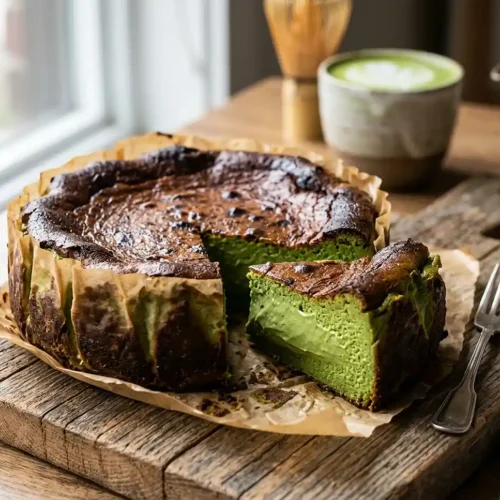
The top should be deeply browned — almost charred — and the center should still have a visible wobble when you shake the tin gently. It will look underdone, and that’s exactly right. The cake finishes setting in the fridge, not the oven.
Can you use low-fat cream cheese for this recipe?
Technically yes, but the texture will be noticeably different — less rich, less creamy, and harder to get completely smooth. Full-fat cream cheese is what gives this cake its signature dense, velvety center. It’s worth it.
Why does basque cheesecake have a burnt top?
The high oven temperature caramelizes the sugars on the surface, creating a bittersweet, slightly smoky crust that contrasts beautifully with the creamy interior. It’s not a mistake — it’s the defining characteristic of the style, and the char adds depth of flavor you can’t get any other way.
Can you freeze matcha basque cheesecake?
Yes. Wrap individual slices tightly in plastic wrap and freeze for up to 1 month. Thaw overnight in the fridge — never at room temperature or in the microwave. The texture softens slightly after freezing but stays enjoyable.
What is the difference between Japanese matcha basque cheesecake and regular basque cheesecake?
The base recipe is almost identical — cream cheese, eggs, sugar, and cream baked at high heat. The matcha version adds matcha powder for an earthy, bittersweet flavor and a vivid green interior. The baking method, texture, and “burnt” top are the same in both.
A Bake Worth Every Minute of Waiting
Matcha basque cheesecake is one of those rare recipes that looks dramatic, tastes complex, and is genuinely easy to pull off at home — the oven and the fridge do most of the work for you.
Made yours? Drop a comment below and tell me how it went — especially if you tried one of the variations. I love hearing about the hojicha version in particular.
If you’re in a matcha mood and want to keep going, this layered matcha mousse cake with its airy, cloud-like texture is the next recipe to bookmark.
Baked with love by Rebeccah Ellene. I’ve made this recipe across six test batches, adjusting the matcha quantity, bake time, and cooling method each time — the version above is the one I’d make for a dinner party without a second thought.
Matcha Basque Cheesecake
Equipment
- 6-inch / 15 cm round cake tin
- Baking paper / parchment
- fine-mesh sieve
- Oven thermometer
Ingredients
Cheesecake Batter
- 450 g Cream cheese room temperature — full-fat only
- 150 g White sugar
- 2 tbsp Matcha powder ceremonial grade preferred for best color and flavor
- 7 g Cornstarch helps the center set without turning rubbery
- 1 tsp Vanilla extract
- 3 Large eggs room temperature
- 180 ml Thickened / heavy cream
Instructions
- Preheat the oven to 240°C / 465°F. Scrunch the baking paper and press it into a 6-inch / 15 cm cake tin, leaving an overhang on the sides. Make sure the oven is fully preheated before the cake goes in.
- Place the cream cheese in a large bowl and beat on medium speed for about 2 minutes until completely smooth. Scrape down the sides of the bowl. Any lumps here will stay in the finished cake.
- Add the sugar and mix until well combined and the mixture looks glossy. Scrape the bowl again before moving to the next step.
- Sift in the matcha powder, then add the cornstarch and vanilla extract. Beat until the batter is completely smooth and lump-free with an even green color throughout. If you see green streaks, keep beating — they will disappear.
- Switch to a whisk and add the eggs one at a time, fully incorporating each before adding the next. Pour in the heavy cream and whisk until the batter is smooth and pourable. Do not over-whisk — you are not trying to add air.
- Pour the batter into the lined tin and bake for 25 minutes. At 25 minutes the top should be deeply browned and the center should still wobble visibly when you shake the tin. If the top is not dark after 25 minutes, bake for 3 to 5 more minutes.
- Open the oven door and wedge in a spoon to keep it slightly ajar. Let the cake rest in the oven for 10 minutes. It will deflate slightly — that is normal.
- Remove the cake from the oven and place it directly in the fridge to cool. Chill for a minimum of 4 hours, or overnight for the best texture and cleanest slices.
- Lift the cake out of the tin using the baking paper overhang. Peel the paper away from the sides. Slice with a warm dry knife and serve at cool room temperature for the creamiest texture.