Lotus Biscoff Milk Cake
Tired of soggy tres leches? This Lotus Biscoff milk cake uses one trick to stay moist without falling apart. Discover the secret inside.
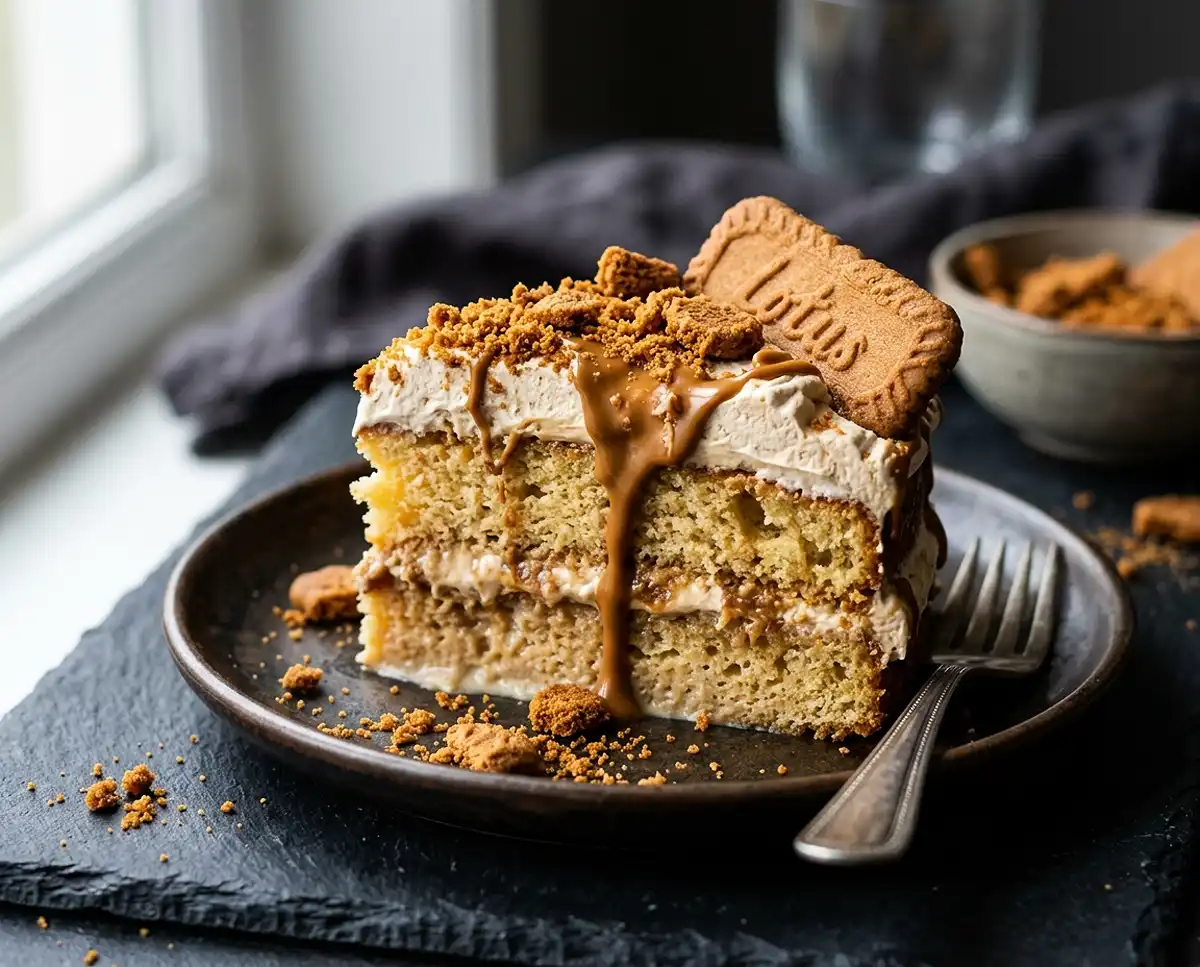
That moment when you bite into a Lotus Biscoff milk cake and the sponge just melts in your mouth—that’s what happens when you get the soak ratio right. Most tres leches cakes drown themselves in milk, turning into a soggy mess, but this one walks the line perfectly: moist enough to soak up all that caramel-cookie flavor, sturdy enough to hold its shape when you slice it.
You’ll need evaporated milk, condensed milk, whole milk, and melted Biscoff spread swirled together, then poked into a light sponge made with cornstarch, eggs, and cinnamon. By the time you top it with Biscoff whipped cream and crushed cookies, you’ve got a dessert that tastes homemade but feels like it came from a bakery.
Table of Contents
How Do You Make a Lotus Biscoff Milk Cake at Home?
Definition: A Lotus Biscoff milk cake is a tender sponge soaked in a three-milk mixture infused with melted Biscoff spread, then topped with Biscoff whipped cream and crushed cookies—it’s crispy on top, creamy in the middle, and tastes like caramel and cinnamon in every bite.
Steps:
- Whisk flour, cornstarch, baking powder, cinnamon, and salt together, then beat eggs and sugar until pale and fluffy before folding everything together gently.
- Bake the sponge at 180°C (350°F) for 22–25 minutes until golden and a toothpick comes out clean, then cool and poke holes all over.
- Whisk evaporated milk, condensed milk, whole milk, and melted Biscoff spread together until smooth, then slowly pour it over the cooled cake.
- Refrigerate the soaked cake for at least 4 hours (overnight is best) so the milk is fully absorbed and the flavors blend.
- Beat cold heavy cream with powdered sugar, vanilla, and melted Biscoff until stiff peaks form, then spread it over the chilled cake.
- Drizzle melted Biscoff on top, sprinkle crushed biscuits over everything, and serve cold with a little reserved milk on the side.
Comparison:
• Three-milk soak vs. single milk: A three-milk mixture (evaporated, condensed, and whole milk) creates richer flavor and better texture than using just one type—the combination of fat and sweetness mimics the density of a professional bakery cake. • Cornstarch in the sponge vs. all-purpose flour alone: Cornstarch keeps the crumb tender and airy even after soaking; all-purpose flour alone absorbs too much liquid and turns gummy. • Biscoff in the soak vs. Biscoff only in the frosting: Adding melted Biscoff directly to the milk mixture means the cake itself tastes like caramel and cinnamon, not just the topping. • Overnight soak vs. 4-hour minimum: Overnight soaking allows the milk to fully distribute and the flavors to marry; 4 hours is the bare minimum, but the cake is noticeably better the next day. • Whipped cream frosting vs. buttercream: Whipped cream stays light and airy, letting the Biscoff flavor shine without the heaviness of butter; it also sets off the richness of the milk soak perfectly.
Verdict: Make this cake for a crowd, keep it in the fridge overnight before serving, and don’t skip the cornstarch—it’s the secret that keeps a tres leches cake from becoming a puddle on your plate.
WHY YOU’LL LOVE THIS RECIPE
This Lotus Biscoff milk cake hits that impossible sweet spot between moist and sturdy—something most home bakers struggle with because they’re afraid of either drying it out or turning it into mush.
• The sponge actually holds together. Most tres leches cakes fall apart when you slice them because the soak is too heavy, but this one uses cornstarch to keep the crumb light and strong enough to support the filling.
• The flavor is deeper than store-bought. Melted Biscoff swirled right into the milk mixture means every layer tastes like caramel and cinnamon, not just the frosting on top—it’s the kind of detail that makes people ask if you’re secretly a pastry chef.
• You can make it ahead without stress. The cake actually improves overnight in the fridge as the milk fully absorbs and the flavors meld. Assemble the frosting in the morning, and you’re done.
• It’s easier than it sounds. No tempering, no special equipment, no techniques you haven’t already done—just a basic sponge, a quick milk mixture, and whipped cream. The hardest part is waiting for it to chill.
• It beats any store-bought cake because you control the amount of Biscoff (you can add more if you want), the texture of the sponge, and how long it soaks—something a factory can never do.
For a similar make-ahead dessert with a different flavor profile, check out our no-bake Biscoff cheesecake that requires zero baking skill.
INGREDIENTS
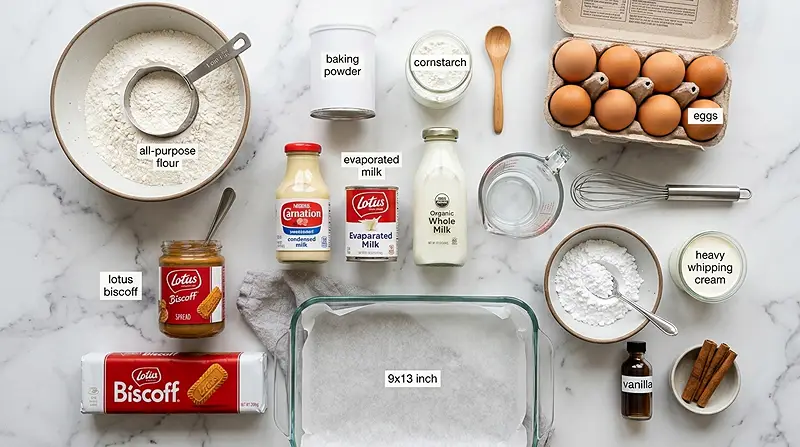
This Biscoff milk cake recipe keeps the soak balanced so you get that creamy, moist texture without the cake collapsing, and the frosting is rich but not heavy. Serves 12.
| Amount | Ingredient |
|---|---|
| 1 cup | All-purpose flour |
| ¼ cup | Cornstarch (keeps cake soft and airy) |
| 1½ tsp | Baking powder |
| ½ tsp | Cinnamon (pairs perfectly with Biscoff) |
| ¼ tsp | Salt |
| 4 large | Eggs (room temperature) |
| 1 cup | Granulated sugar |
| ¼ cup | Milk |
| 2 tbsp | Oil |
| 1 tbsp | Vanilla extract |
| 1 can | Evaporated milk |
| 1 can | Condensed milk |
| 1 cup | Whole milk (reduced from 1½ to prevent sogginess) |
| ½ cup | Lotus Biscoff spread (melted) |
| 2 cups | Heavy cream (cold) |
| ⅓ cup | Lotus Biscoff spread (melted & cooled) |
| 3 tbsp | Powdered sugar |
| 1 tsp | Vanilla extract |
| — | Crushed Lotus Biscoff biscuits (for garnish) |
| — | Melted Biscoff drizzle (for garnish) |
Per Serving: 420 calories · 5g protein · 48g carbs · 23g fat
If you’re watching portions, this cake is rich—a smaller slice with fresh fruit or coffee is perfect, and it keeps you satisfied without needing seconds (even though you’ll want them).
WHAT EQUIPMENT DO YOU NEED?
Essential:
• 9×13 inch baking pan (standard rectangular cake pan—nothing fancy needed).
• Hand mixer or stand mixer (you need to beat eggs and sugar for 5 minutes until pale; a whisk won’t cut it).
• Large mixing bowls (two—one for dry ingredients, one for wet).
• Whisk (for combining flour and other dry ingredients smoothly).
• Measuring cups and spoons (get them right or the soak-to-crumb ratio suffers).
• Toothpick or cake tester (to check if the sponge is baked through without cutting into it).
• Skewer or fork (for poking holes in the cake so the milk soaks in).
Optional but helpful:
• Offset spatula (spreads frosting smoothly, but a regular knife works fine).
• Food processor (crushes Biscoff biscuits in seconds, but you can put them in a zip-top bag and smash with a rolling pin).
• Refrigerator thermometer (makes sure your cake is stored cold enough; milk-soaked cakes should stay below 40°F).
STEP-BY-STEP INSTRUCTIONS
How Do You Make a Lotus Biscoff Milk Cake Step by Step?
Making this Lotus Biscoff milk cake is a two-day process, but most of that time is just the fridge doing the work while you do something else.
1. Preheat and Prep
Set your oven to 180°C (350°F) and grease a 9×13 inch pan with butter or cooking spray—get into the corners so the edges don’t stick. Line the bottom with parchment if you want the easiest cleanup ever.
2. Mix the Dry Ingredients
Whisk together flour, cornstarch, baking powder, cinnamon, and salt in a large bowl—don’t skip the whisking, it aerates the flour and helps the cake rise evenly. If you see any lumps of cinnamon or baking powder, break them up with the back of a spoon.
3. Beat the Eggs and Sugar
In another bowl, beat eggs and sugar together with a hand mixer on medium-high speed for 5 minutes until the mixture is pale, fluffy, and roughly tripled in volume. You’ll know it’s ready when it looks like thick, creamy mousse—this is what traps air and makes the cake light. [If your eggs are cold, warm them in a bowl of hot water for 2 minutes first; room-temperature eggs beat better and trap more air.]
4. Add Milk, Oil, and Vanilla
Reduce the mixer speed to medium and add milk, oil, and vanilla, beating just until combined—the mixture will look a little broken at first, but keep going for 20 seconds until it comes together. Stop as soon as you see everything combined; don’t overmix or you’ll deflate all those air bubbles you just created.
5. Fold in the Dry Ingredients
Add the dry ingredients in three batches, folding gently with a spatula each time instead of stirring—this keeps the batter light and airy. Use a folding motion: cut down the middle, sweep across the bottom, and flip the batter over itself. Stop as soon as no white streaks of flour show; overmixing now turns the cake tough and dense.
6. Bake the Sponge
Pour the batter into your prepared pan and smooth the top with a spatula. Bake for 22–25 minutes until the top is light golden and a toothpick inserted in the center comes out clean or with just a few moist crumbs. The cake should spring back slightly when you touch the center; if it feels soft and jiggly, give it 2 more minutes.
7. Cool the Cake
Let the cake cool in the pan for 30 minutes at room temperature—this lets the structure set before you add liquid. After 30 minutes, turn it out onto a wire rack if you like, or leave it in the pan (the pan actually keeps it from drying out faster).
8. Poke Holes All Over
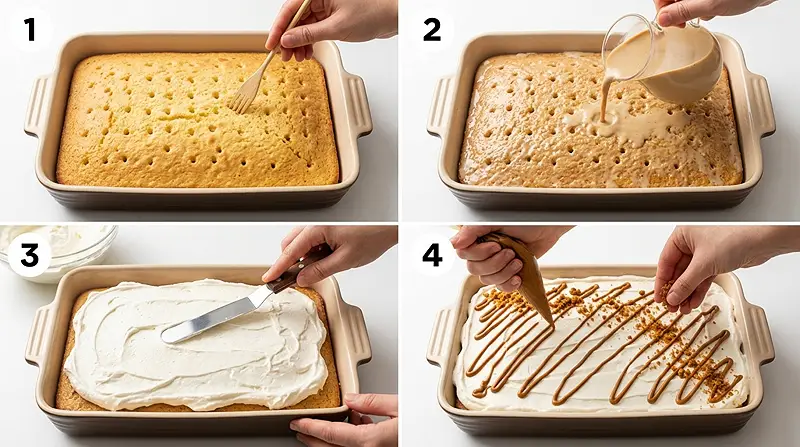
Once the cake is completely cool, use a fork, skewer, or toothpick to poke holes all over the surface, going about halfway down into the cake—you want hundreds of tiny holes so the milk can seep in deep without the cake falling apart. [The holes should be close enough that you can see them everywhere, but not so close that the cake becomes fragile; aim for roughly ½ inch apart.]
9. Make the Biscoff Milk Mixture
While the cake cools, whisk together evaporated milk, condensed milk, and whole milk in a bowl. In a separate small bowl or mug, melt the Biscoff spread (microwave it in 15-second bursts, stirring between each, or warm it gently over low heat).
Once melted and slightly cooled, whisk it into the milk mixture until smooth and no clumps remain. [If the Biscoff clumps up, warm the entire mixture gently on the stovetop over low heat and whisk again; don’t let it simmer or the condensed milk will scorch.]
10. Soak the Cake
Slowly pour the milk mixture over the cooled cake, starting at one corner and working your way across—let it pool and seep in naturally; don’t rush it. Reserve about ½ cup of the mixture to serve on the side. Cover the pan with plastic wrap and refrigerate for at least 4 hours, but overnight is genuinely better; the cake gets noticeably softer and the flavors blend together into something really special.
11. Make the Biscoff Whipped Cream
Remove the cake from the fridge about 15 minutes before you plan to frost it. Pour heavy cream into a chilled bowl and beat with a hand mixer on medium speed until it’s slightly thick—you’ll see soft peaks starting to form.
Add powdered sugar, vanilla, and melted (but cooled) Biscoff spread, then beat on medium-high until stiff peaks form—the frosting should hold its shape when you lift the beaters. [Don’t overwhip or the cream will turn grainy and separate; stop as soon as the peaks stand straight up.]
12. Frost and Garnish
Spread the Biscoff whipped cream evenly over the chilled cake with an offset spatula or the back of a spoon. Drizzle melted Biscoff over the top in a pattern (or just let it fall where it will—it all looks good). Sprinkle crushed Biscoff biscuits over the top so you get that crispy texture in every bite. Serve cold.
PRO TIPS FOR PERFECT BISCOFF CREAM MILK CAKE
The cornstarch is non-negotiable.
Cornstarch isn’t a filler—it’s a structural ingredient. According to King Arthur Baking’s guide to cake flour substitutions, cornstarch is a soft starch that stays tender even when exposed to liquid and heat, which is exactly what happens in a tres leches cake.
When you replace 2 tablespoons of all-purpose flour with cornstarch per cup, you get a crumb that soaks up the milk without becoming gummy. I learned this after my first attempt turned into cake soup, and it changed everything.
Make the cake the day before.
I used to frost this cake right after soaking, thinking the sooner I served it, the better. Wrong. When you let it sit overnight, the milk fully distributes through every layer, the flavors settle and deepen, and the cake becomes noticeably softer and more cohesive. Twenty-four hours in the fridge is the sweet spot—the cake is tender, the soak is complete, and the frosting adheres better to a cold cake.
Cold cream beats warm cream.
This one’s simple: use heavy cream straight from the fridge. Warm cream whips slower and doesn’t hold peaks as well; cold cream goes from liquid to stiff peaks in about 3 minutes and stays stable for hours. If your kitchen is very warm, chill your mixing bowl and beaters for 5 minutes before you start.
Toast your crushed biscuits lightly.
If you have time, spread your crushed Biscoff biscuits on a small baking sheet and toast them at 160°C (320°F) for 3–4 minutes just before garnishing—it deepens the caramel flavor and makes them extra crispy instead of a little soft from the cake’s moisture. It’s a small move that makes the topping taste restaurant-quality.
Reserve half the milk mixture for serving.
Don’t pour all the milk mixture into the cake—keep ½ cup on the side and pour a little over each slice when you serve it. It keeps the cake moist even a day or two later, and it gives you a way to adjust the richness if someone prefers their slice less soaked. It’s also visually dramatic, like you’re giving them a little sauce course.
TROUBLESHOOTING: WHEN SOMETHING GOES WRONG
Why did my cake come out dense and heavy?
You either overmixed the batter or didn’t beat the eggs and sugar long enough at the start. Eggs and sugar need a full 5 minutes of beating to trap enough air for a light crumb. Next time, use a timer and beat for the full time; if you mixed the batter too vigorously after adding the dry ingredients, you deflated all that air. Gentle folding is your friend.
Can I use store-bought Biscoff spread instead of melting whole biscuits?
Yes—that’s exactly what this recipe uses, and it’s the easiest option. Store-bought spread is already smooth and pourable, so you just melt it gently and whisk it into the milk. If you want to make Biscoff spread from scratch, you’d need to grind whole biscuits with oil in a food processor for a long time, which isn’t worth it for this cake.
Is the cake supposed to feel mushy in the middle even after overnight refrigeration?
A little soft, yes—that’s the point of the soak. But if it’s falling apart when you slice it, you used too much milk or the soak went too long (past 36 hours). Next time, follow the 4-hour minimum and overnight maximum, and drain any excess milk that pooled on the bottom before frosting.
What if the Biscoff spread clumped up when I mixed it with the milk?
Warm the entire mixture gently over low heat on the stovetop while whisking constantly—the clumps will dissolve as the mixture warms. Don’t microwave it (the condensed milk can scorch), and don’t let it get hot enough to simmer. Once smooth, let it cool before pouring.
Can I make this cake without condensed milk?
Not really—condensed milk adds sweetness and a specific thick texture that you can’t replicate with regular milk and sugar. If you want to try, you’d need to use extra evaporated milk and add 3–4 tablespoons of honey or corn syrup, but the result won’t be the same. Stick with the three-milk formula if you want the authentic texture.
Why is my whipped cream separating or turning grainy?
You overwhipped it. Whipped cream has a narrow window between soft peaks and graininess; as soon as you see stiff peaks form, stop immediately and move on. If it does separate, you can try folding in a fresh tablespoon of cold heavy cream and gently re-whipping, but it’s easier to just start over with a fresh batch. Make sure your bowl and beaters are cold before you start.
VARIATIONS & WAYS TO CUSTOMIZE
You can adapt this Biscoff cream milk cake for different seasons, dietary preferences, or flavor twists without losing the core magic of the soak and the frosting.
Cinnamon-Spiced Version
Add an extra ½ teaspoon of cinnamon to the sponge and a pinch of nutmeg and clove to the milk mixture—this gives the cake a more autumnal, spiced-cake vibe that works beautifully in fall. The Biscoff flavor already has caramel notes, so the extra spices just deepen that warmth without overwhelming it.
Gluten-Free Swap
Replace all-purpose flour with a 1:1 gluten-free flour blend and keep the cornstarch the same—the structure comes from the cornstarch, so the gluten-free flour mainly adds flavor and some body.
The cake may bake 2–3 minutes faster, and it might be slightly less fluffy, but it’ll still be tender and moist from the soak. For a full guide to making this work reliably, see our gluten-free baking tricks that actually work.
Dairy-Free Biscoff Milk Cake
Use oat milk or coconut milk in place of whole milk, canned coconut milk (the full-fat kind) instead of evaporated milk, and a coconut-based condensed milk alternative. The soak will be slightly less rich, but it’ll still work—Biscoff flavor is strong enough to carry the cake.
Use aquafaba (the liquid from a can of chickpeas) or a store-bought vegan whipped cream for the frosting; aquafaba whips almost identically to egg whites, but take time to chill your bowl first.
White Chocolate & Biscoff Twist
Add ¼ cup of melted white chocolate to the milk mixture and ¼ cup to the whipped cream frosting—white chocolate’s sweetness and vanilla notes work beautifully with the Biscoff’s caramel, creating a richer, more complex flavor profile. This version feels more luxurious and is perfect for special occasions.
SERVING, STORING & REHEATING
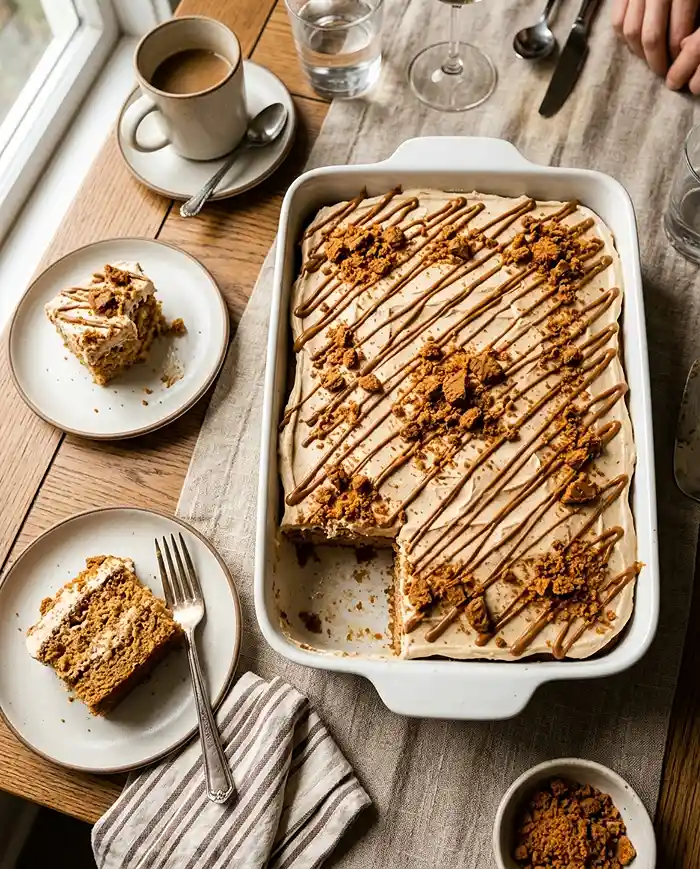
Can You Make a Lotus Biscoff Milk Cake Ahead of Time?
Serving
Slice the cake with a sharp, warm knife (dip it in hot water and wipe it dry between cuts) so you get clean slices instead of the frosting dragging. Serve directly from the fridge so the sponge and frosting are cold and the textures are at their best.
Pour a little of that reserved milk mixture over each slice—it adds visual drama, keeps the cake moist, and tastes incredible. Pair it with strong coffee or a glass of cold milk.
Storing
Cover the frosted cake with plastic wrap and keep it in the fridge for up to 3 days—the frosting stays stable, the sponge stays moist, and the Biscoff flavor actually deepens as it sits. Don’t leave it at room temperature for more than 2 hours or the whipped cream will start to weep.
If you need to store unfrosted soaked cake, it keeps for up to 4 days covered; the texture gets softer and more custard-like, which some people prefer.
Reheating
Don’t reheat this cake—it’s meant to be served cold, and heat would melt the frosting and change the sponge texture. If it’s been in the fridge and you want it to be slightly less cold, let it sit at room temperature for 15 minutes before serving, but never put it back in the oven or microwave.
FREQUENTLY ASKED QUESTIONS
How long does it take to make a Lotus Biscoff milk cake from start to finish?
About 1 hour of active work (baking, mixing, soaking prep), then at least 4 hours of chilling before you frost it. If you make the cake one day and frost it the next, the total hands-on time is split across two days, which makes it easy for a crowd. Plan for overnight refrigeration for the best flavor and texture.
Can you use regular butter cookies instead of Lotus Biscoff?
Lotus Biscoff is pretty specific—the spread version is smooth and pourable, and the flavor (that caramel, cinnamon, burnt-sugar thing) is hard to replicate. Regular butter cookies don’t give you the same liquid-like spread, so you’d be making a different cake. Stick with Biscoff, or look for other caramel-spiced cookie spreads like cookie butter from other brands.
What’s the difference between this milk cake and a regular tres leches cake?
A classic tres leches uses plain milk, condensed milk, and evaporated milk—nothing else. This version adds Biscoff spread directly to the soak, so the cake itself is flavored, not just the frosting. It’s also soaked less heavily (regular tres leches can be dripping wet), so it stays sliceable and doesn’t fall apart.
Can you freeze this cake?
You can freeze the unfrosted, soaked sponge for up to 2 weeks wrapped tightly in plastic, but don’t freeze the whipped cream frosting—it’ll separate when it thaws. Thaw the cake overnight in the fridge, frost it fresh, and serve. Freezing the finished cake is not recommended because the texture of whipped cream changes unpredictably.
Is there a vegan version of this cake?
Yes—use a flax or chia egg (1 tablespoon ground flax or chia plus 3 tablespoons water, mixed and rested 5 minutes) per egg in the sponge, swap all dairy milk for plant-based milk, use canned full-fat coconut milk for the evaporated milk, and use a coconut condensed milk alternative or make your own (blend coconut milk with powdered sugar). The frosting can be aquafaba or store-bought vegan whipped cream. The cake will be slightly denser, but still tender and delicious.
CLOSING & AUTHOR
A Lotus Biscoff milk cake is the kind of dessert that makes people slow down and actually taste what they’re eating—every layer has something different going on, from the crispy crushed cookies to the caramel soak to the light cream frosting.
If you try this recipe, let me know what you think in the comments, or share a photo of your version—I love seeing how people make it their own. For another make-ahead dessert that’s equally impressive but takes a totally different approach, try our cookie butter gooey butter cake.
After testing this recipe across five batches and adjusting the milk-to-sponge ratio until it was perfect, I learned that the real secret isn’t a fancy technique—it’s respecting the sponge enough to keep it light, and the soak enough to let it do its job slowly.