Creme Brulee Donuts
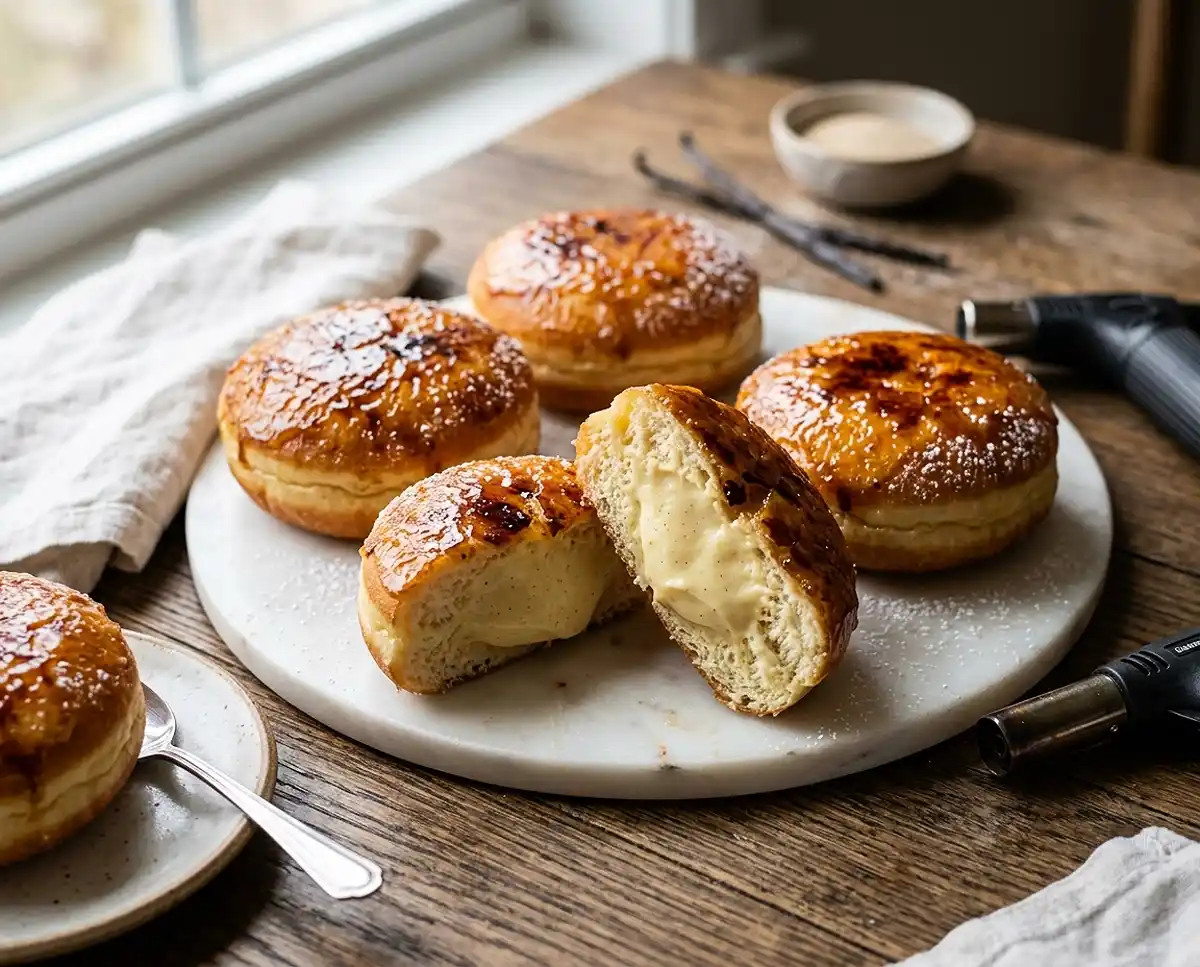
These creme brulee donuts crack just like the real thing. Pillowy dough, silky vanilla custard, real caramel shell. Get the foolproof recipe — make them today.
Creme brulee donuts were the first thing I ever made that stopped people mid-sentence to ask for the recipe before they’d even finished chewing.
This post gives you everything — the exact dough ratio that keeps them soft for hours, the custard trick that makes filling seamless, and the caramel method that gives you a real, glassy crack instead of a sticky mess.
These creme brulee donuts are yeasted rings of soft, eggy dough, fried until golden, piped full of silky vanilla custard made from egg yolks, whole milk, and cornstarch, then dipped in a hot sugar-and-water caramel that sets into a thin, shattering shell on top.
I first had a version of these at a tiny bakery that sold out before 9 a.m. every single day. I spent three weeks reverse-engineering them at home, burning my fingers on caramel more times than I’d like to admit.
Table of Contents
How Do You Make Creme Brulee Donuts at Home?
Creme brulee donuts are yeasted, fried dough rounds filled with chilled vanilla custard and dipped in hardened caramel — rich, creamy, and finished with a signature sugar crack.
- Activate yeast in lukewarm milk with sugar until foamy, then mix in egg yolks and vanilla.
- Knead flour, butter, salt, and the yeast mixture into a soft, elastic dough and let it rise until doubled.
- Whisk egg yolks with sugar and cornstarch, temper in hot milk, then cook the custard until thick and glossy.
- Cut dough into 3-inch rounds, let them puff for 20–30 minutes, then fry in 360°F oil until deep golden on both sides.
- Pipe chilled custard into each cooled donut through a skewer-made pocket until slightly heavy.
- Dip the top of each filled donut in hot caramel, tilt to drain the excess, and set on parchment to harden.
- Fried vs. Baked: Fried gives a crisp exterior and soft crumb; baked produces a drier, denser result.
- Air fryer vs. Deep fry: Air fryer creme brulee donuts work but lack the even browning of oil frying.
- Cornstarch vs. Flour custard: Cornstarch sets cleaner and slices without weeping; flour-based is thicker but heavier.
- Caramel dip vs. Torched sugar: Caramel dip gives a uniform shell; torch works but requires granulated sugar on top of each donut.
Fry these fresh, fill them cold, and dip in caramel right before serving for the clearest crack and best texture.
Why You’ll Love This Creme Brulee Donut Recipe
This creme brulee donut recipe delivers bakery results without specialty equipment — just a stand mixer, a pot, and a candy thermometer if you want one.
- The texture contrast is unreal. You get the caramel crack, the chewy fried dough, and the cold, silky custard all in one bite — nothing else quite compares.
- Easier than it looks. The dough comes together in one bowl, the custard is a standard pastry cream, and the caramel is a simple wet caramel with no thermometer required.
- Testing note: I found that rolling the dough to exactly 1/2 inch — not thinner — kept the donuts from collapsing around the custard when filled. Under-rolled rounds just couldn’t hold it.
- Beats anything store-bought. Commercial versions use shelf-stable pastry cream that tastes flat next to a real egg-yolk custard made the same day.
- Make-ahead friendly. Both the dough and the custard can be prepped a day ahead so you’re only frying and assembling on the day.
If you love custard-filled pastries, you’ll also want to check out the step-by-step method for making eclair donuts with pastry cream — a lighter, choux-based cousin to this recipe.
What Do You Need for the Creme Brulee Donut Recipe?
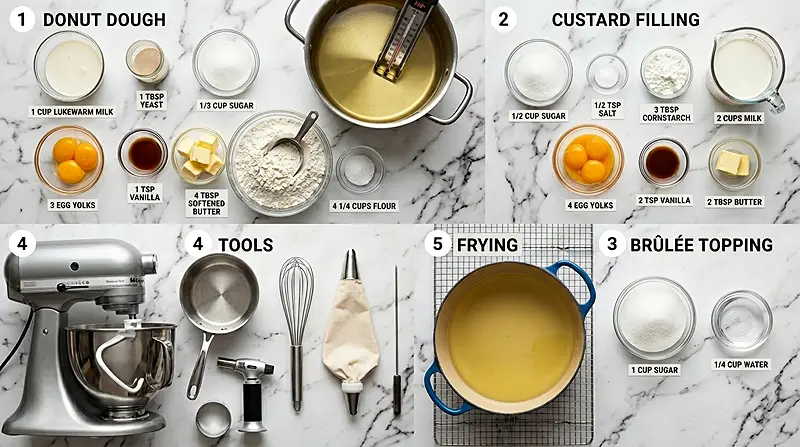
This baked creme brulee donut recipe — or fried, depending on your method — uses straightforward pantry ingredients across three components: the dough, the custard, and the caramel.
| Amount | Ingredient |
|---|---|
| Donuts (makes 15) | |
| 1 cup | Milk, lukewarm (100–110°F — too hot kills the yeast) |
| 1 tbsp | Active dry yeast |
| 1/3 cup | Granulated sugar |
| 3 | Egg yolks |
| 1 tsp | Vanilla extract |
| 4 tbsp | Butter, softened |
| 4 1/4 cups | All-purpose flour |
| 1 1/2 tsp | Salt |
| As needed | Vegetable oil for frying |
| Custard Filling | |
| 1/2 cup | Granulated sugar |
| 1/2 tsp | Salt |
| 3 tbsp | Cornstarch (gives a silky, clean set — don’t swap for flour) |
| 2 cups | Whole milk |
| 4 | Egg yolks |
| 2 tsp | Vanilla extract |
| 2 tbsp | Unsalted butter |
| Brulee Caramel | |
| 1 cup | Granulated sugar |
| 1/4 cup | Water |
Per Serving (1 donut): Approx. 380 cal · 6g protein · 52g carbs · 16g fat
These are a treat, so enjoy them fresh and unhurried — they’re more satisfying when you’re not rushing the caramel.
What Equipment Do You Need?
- Stand mixer with dough hook — Essential for kneading the enriched dough to the right elasticity without overworking by hand.
- Large heavy-bottomed pot — Essential for safe, even oil frying at 360°F.
- Kitchen thermometer — Essential for monitoring oil temperature; 20 degrees off either way affects the crust.
- Medium saucepan — Essential for cooking both the custard and the caramel.
- Piping bag with filling tip — Essential for getting custard cleanly into the center of each donut.
- Skewer or chopstick — Essential for creating the custard pocket inside each donut.
- 3-inch round biscuit or cookie cutter — Essential for uniform rounds that cook evenly.
- Slotted spoon or spider strainer — Essential for lifting donuts from hot oil safely.
- Heat-resistant gloves — Optional but strongly recommended for the caramel dipping step.
- Rolling pin — Standard; needed for rolling dough to consistent 1/2-inch thickness.
How Do You Make Creme Brulee Donuts Step by Step?
Making creme brulee donuts moves in three stages — dough, custard, and assembly — and getting the custard chilled while the dough rises is the key to smooth timing.
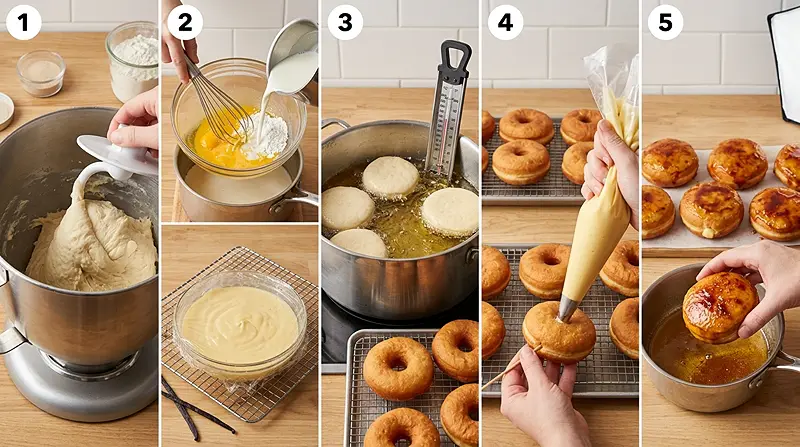
Make the Dough
- Whisk the lukewarm milk, yeast, and 1 tsp of the sugar in a small bowl. Let it sit for 10–15 minutes until the surface is foamy and fragrant. [If it doesn’t foam, the yeast is dead — start over with fresh yeast.]
- Add the egg yolks and vanilla to the yeast mixture and stir to combine — the mixture will look slightly curdled, which is fine.
- Add the yeast mixture, flour, butter, salt, and remaining sugar to your stand mixer bowl. Mix on low with the dough hook, then increase to medium and knead for 5–10 minutes until the dough is smooth, soft, and springs back when poked. [If dough sticks badly to the bowl after 5 minutes of kneading, add flour 1 tbsp at a time — but resist adding too much or the donuts will be dense.]
- Transfer the dough to a lightly greased bowl, cover with plastic wrap, and let it rise in a warm, draft-free spot for 1–2 hours until doubled in size.
Make the Custard Filling
- Whisk the sugar, salt, and cornstarch together in a bowl, then beat in the egg yolks until the mixture is pale yellow and slightly thickened, about 1 minute.
- Heat the milk in a saucepan over medium-high heat just until it barely simmers — small bubbles at the edges, not a rolling boil. Remove from heat.
- Slowly ladle the hot milk into the egg yolk mixture while whisking constantly to temper it without scrambling the yolks. [If you pour too fast, you’ll get sweet scrambled eggs — go slowly and keep whisking.]
- Pour the mixture back into the saucepan and cook over medium heat, whisking continuously, until it thickens and large bubbles pop at the surface — about 3–5 minutes.
- Remove from heat, whisk in the vanilla and butter until smooth, then press plastic wrap directly against the surface and refrigerate for 1–2 hours until fully chilled and set.
Shape and Fry the Donuts
- Punch the risen dough down, turn it out onto a lightly floured surface, and roll to 1/2-inch thick — use a ruler if you’re not sure, because thickness here directly affects how much custard each donut can hold.
- Cut rounds with a 3-inch biscuit cutter, re-roll the scraps, and cut until the dough is used. Place rounds on a greased baking sheet with 1 inch of space between them, cover, and let rise for 20–30 minutes until puffed.
- Heat vegetable oil in a large pot to 360°F. Working in batches to avoid crowding, lower rounds gently into the oil. [Crowding drops the oil temperature and gives you greasy, pale donuts instead of golden ones.]
- Fry for 1–2 minutes until golden on the bottom, flip carefully, and fry 1 more minute. Remove with a slotted spoon onto a paper towel-lined plate and let cool completely before filling.
Fill and Brulee
- Transfer the chilled custard to a piping bag fitted with a filling tip. Use a skewer or chopstick to poke a deep pocket into the side of each cooled donut — wiggle it slightly to create room for the custard.
- Insert the piping tip into each pocket and fill until you feel slight resistance and the donut feels heavier. [Don’t overfill or the donut will burst — stop when you feel the first push-back.]
- Add the sugar and water for the caramel to a small saucepan over medium-high heat. Once bubbling, reduce to medium and swirl occasionally — do not stir with a spoon — until the caramel turns a deep amber gold.
- Remove from heat and swirl the pan until the color deepens just slightly. Working quickly and carefully, dip the top of each filled donut into the caramel. Tilt away from your fingers to let excess drip, then set on parchment to harden. [If caramel gets too stiff mid-batch, return the pan to low heat and swirl until it loosens — do not add water.]
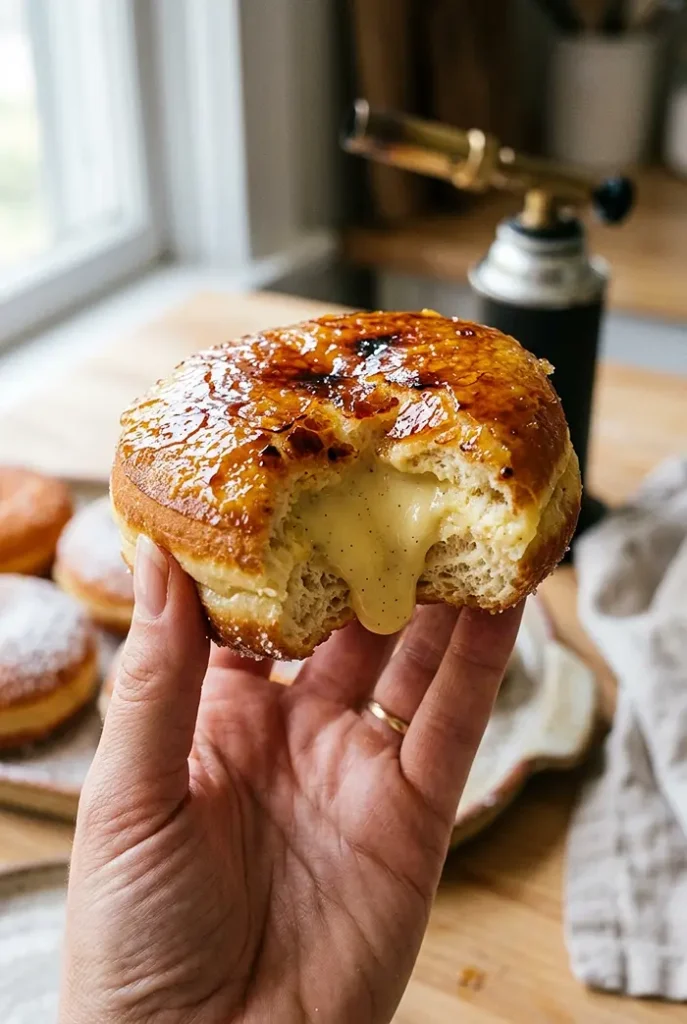
Pro Tips for Perfect Vanilla Custard Donuts
Getting vanilla custard donuts right every time comes down to a few details that recipes often leave out — here’s what actually makes the difference.
Control your oil temperature religiously. The moment you add donuts to the pot, the oil temperature drops. Use a thermometer and give the oil 1–2 minutes between batches to come back to 360°F. Frying at 340°F produces pale, greasy results; frying at 380°F gives you a dark crust with a raw-feeling center.
Cold custard fills more cleanly. I tested filling donuts at room temperature versus straight from the fridge, and the chilled custard stays in place much better — it doesn’t weep back out of the pocket. Refrigerate the custard for the full 2 hours before filling, even if it feels like it’s already thick enough.
The science behind tempering your custard: When you ladle hot milk into egg yolks gradually, you’re raising their temperature slowly enough that the proteins don’t seize and curdle. According to Serious Eats’ guide to making pastry cream, using cornstarch protects egg proteins from curdling under heat, which is why cornstarch-based custards are more forgiving than flour-based ones over direct flame.
Don’t let the caramel cool before you start dipping. You have a 3–4 minute working window with a wet caramel before it becomes too viscous to coat evenly. Have all your filled donuts lined up and ready before you take the caramel off the heat. Speed and confidence are everything in this step.
Troubleshooting: When Something Goes Wrong
Why did my donuts come out greasy instead of golden?
The oil temperature was too low when the donuts went in. Oil below 355°F gets absorbed into the dough rather than creating a fast crust. Always check the temperature after each batch and wait for it to recover before adding the next round.
Why is my custard lumpy after cooking?
The milk was poured too fast into the egg yolks, or the mixture wasn’t whisked constantly during cooking. If you catch lumps early, strain the custard through a fine mesh sieve right away — it saves the batch in most cases.
Why did my caramel slide off the donuts?
The donuts were still warm, or the surface was oily. Caramel needs a clean, room-temperature, dry surface to adhere and harden. Let donuts cool completely on a wire rack after frying and pat any excess oil off the tops before dipping.
Why didn’t my dough rise?
The milk was too hot and killed the yeast, or the yeast was old. Lukewarm means 100–110°F — warmer than body temperature but not hot. If the yeast mixture doesn’t foam after 15 minutes, don’t continue; start over with fresh yeast.
Why is my custard leaking out of the donuts after filling?
The custard wasn’t chilled long enough, or the donuts were overfilled. The custard needs at least 2 hours in the fridge to set firmly, and you should stop filling the moment you feel resistance from the pocket.
How Can You Customize This Creme Brulee Donut Recipe?
The base creme brulee donut recipe is a solid foundation — and it takes to variations really well once you’ve made it once.
- Seasonal / Holiday Twist: Add 1 tsp cinnamon and 1/4 tsp cardamom to the dough at the mixing stage for a warm spiced version that works beautifully in autumn. The caramel topping picks up the cinnamon and turns into something closer to a churro-caramel combination.
- Chocolate Custard Filling: Whisk 2 tbsp Dutch-process cocoa powder into the dry custard mixture before cooking. The result is a darker, bittersweet filling that contrasts the sweet caramel shell in the best possible way.
- Gluten-Free Version: Swap the all-purpose flour for a 1:1 gluten-free baking flour blend that includes xanthan gum. The dough will be slightly stickier and may need an extra 30 minutes of rising time — work with lightly oiled hands instead of adding more flour. For a full guide to gluten-free yeasted doughs, search for a dedicated resource, as the adjustments go beyond ingredient swapping.
- Citrus Brulee: Add 1 tbsp fresh orange zest to the custard along with the vanilla. It brightens the filling significantly and makes the whole donut taste lighter and more aromatic, especially in summer.
If you’re craving something with a similar custard-meets-fried-dough profile but without the caramel step, the classic New Orleans beignets dusted in powdered sugar are a wonderful lighter variation worth bookmarking.
Can You Make Creme Brulee Donuts Ahead of Time?
Serving
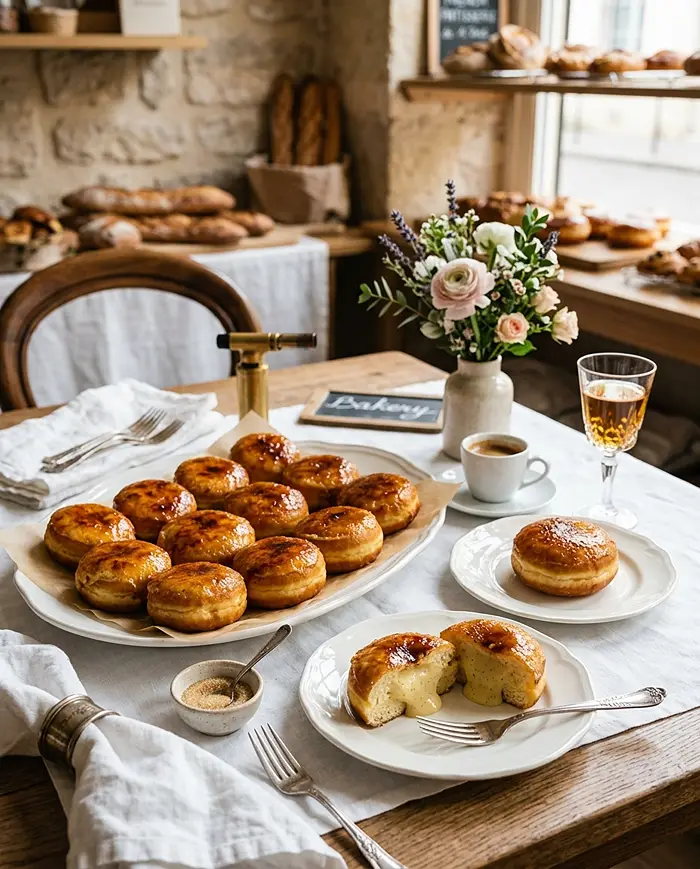
These are at absolute peak within 2 hours of assembly — the caramel is crisp, the custard is cold, and the dough is still soft. Serve them on a flat tray so the caramel tops stay intact, and let people break through the shell themselves for the full brûlée experience.
Storing
Store filled and brûléed donuts in a single layer in the refrigerator for up to 2 days. The caramel will soften overnight from the humidity in the fridge — it’s still delicious but loses the crack. If you want to preserve texture, store the dough and custard separately and assemble day-of.
Unfilled fried donuts keep well at room temperature for up to 1 day, tightly wrapped. The custard keeps refrigerated for up to 3 days.
Reheating
Warm a plain unfilled donut in a 300°F oven for 5 minutes to restore some softness — do not microwave, as it makes the dough rubbery. Filled and brûléed donuts don’t reheat well and are best eaten as-is from the fridge or at room temperature.
Frequently Asked Questions
How do you make air fryer creme brulee donuts?
Air fryer creme brulee donuts follow the same dough and custard method, but instead of frying in oil, you brush the rounds with melted butter and air fry at 350°F for 7–9 minutes, flipping halfway, until golden. The texture is slightly drier and less chewy than traditionally fried donuts, but the caramel dip and custard filling work exactly the same way.
Can you bake creme brulee donuts instead of frying them?
Yes — baked creme brulee donuts work if you prefer to avoid frying. Bake shaped rounds at 375°F for 12–15 minutes until lightly golden. The interior will be fluffier and drier than fried, similar to a dinner roll texture, but the custard filling and caramel topping still deliver the creme brulee experience.
What is the best way to fill donuts with custard without a piping bag?
Use a zip-lock bag with one corner snipped off as a substitute. The opening should be about 1/4 inch. Poke the pocket with a skewer first, then insert the bag tip and squeeze steadily. It’s messier than a proper piping tip but absolutely works in a pinch.
Why does my caramel crack instead of forming a smooth shell?
Caramel that cracks unevenly was either too cool when applied or had crystallized slightly during cooking. Make sure you don’t stir the caramel with a spoon — only swirl the pan — and dip the donuts while the caramel is still fluid and amber-colored, not dark brown.
Can you make the dough the night before?
Yes — after the first rise, punch the dough down, wrap tightly in plastic, and refrigerate overnight. The next day, let it come to room temperature for 30 minutes before rolling and cutting. Cold fermentation actually improves the flavor of the dough slightly, giving it a deeper, more complex yeasty taste.
Ready to Make Creme Brulee Donuts?
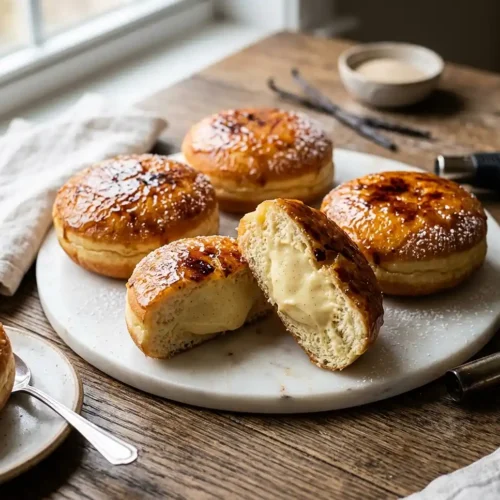
Creme brulee donuts are one of those recipes where the effort genuinely pays off in a way that’s visible, audible, and absolutely worth it — that caramel crack alone is reason enough.
If you try this recipe, drop a comment below and tell me which part surprised you most — I’d love to hear how your caramel turned out.
And if you’re on a custard kick, don’t miss the silky hibiscus panna cotta made without gelatin sheets — a no-fuss dessert that pairs beautifully with the same vanilla custard skills you just practiced.
Baked with love by Rebeccah Ellene. This recipe was tested across five full batches — two with different caramel temperatures, one with room-temperature custard versus chilled, and two full run-throughs to nail the dough hydration at high altitude.
Creme Brulee Donuts
Equipment
- Stand mixer with dough hook
- Large heavy-bottomed pot
- Kitchen thermometer
- Medium saucepan
- Piping bag with filling tip
- Skewer or chopstick
- 3-inch round biscuit or cookie cutter
- Slotted spoon or spider strainer
- Rolling Pin
- Heat-resistant gloves
Ingredients
Donut Dough
- 1 cup Milk lukewarm, 100–110°F
- 1 tbsp Active dry yeast
- ⅓ cup Granulated sugar
- 3 Egg yolks
- 1 tsp Vanilla extract
- 4 tbsp Butter softened
- 4 ¼ cups All-purpose flour
- 1 ½ tsp Salt or to taste
- Vegetable oil for frying
Custard Filling
- ½ cup Granulated sugar
- ½ tsp Salt or to taste
- 3 tbsp Cornstarch do not substitute with flour
- 2 cups Whole milk
- 4 Egg yolks
- 2 tsp Vanilla extract
- 2 tbsp Unsalted butter
Brulee Caramel
- 1 cup Granulated sugar
- ¼ cup Water
Instructions
- Activate the yeast: Whisk the lukewarm milk, yeast, and 1 tsp of the sugar together in a small bowl. Let the mixture sit for 10–15 minutes until foamy and fragrant. If it does not foam, discard and start again with fresh yeast.
- Mix the dough: Add the egg yolks and vanilla to the yeast mixture and stir to combine. Add the yeast mixture, flour, softened butter, salt, and remaining sugar to the bowl of your stand mixer fitted with the dough hook. Mix on low then increase to medium and knead for 5–10 minutes until the dough is smooth, soft, and elastic.
- First rise: Transfer the dough to a lightly greased bowl, cover with plastic wrap or a clean kitchen towel, and allow it to rise in a warm, draft-free spot for 1–2 hours until doubled in size.
- Make the custard base: Whisk the sugar, salt, and cornstarch together. Beat the egg yolks in a medium bowl until smooth, then add the dry mixture and continue beating until combined and pale yellow, about 1 minute.
- Cook the custard: Heat the milk in a saucepan over medium-high heat until it just barely simmers. Remove from heat and slowly ladle the hot milk into the egg yolk mixture while whisking constantly to temper it. Pour the mixture back into the saucepan and cook over medium heat, whisking continuously, until thick and bubbling, about 3–5 minutes.
- Finish and chill the custard: Remove from heat and whisk in the vanilla and butter until smooth. Transfer to a bowl and press plastic wrap directly against the surface to prevent a skin from forming. Refrigerate for 1–2 hours until completely chilled and set.
- Shape the donuts: Punch the risen dough down and turn it out onto a lightly floured surface. Roll to 1/2-inch thick. Cut rounds using a 3-inch biscuit cutter, re-roll the scraps, and continue cutting until the dough is used up.
- Second rise: Place the rounds on a lightly greased baking sheet with about 1 inch of space between each. Cover and allow to rise for 20–30 minutes until puffed and doubled in size.
- Fry the donuts: Heat vegetable oil in a large pot to 360°F. Working in batches, carefully lower the rounds into the hot oil. Fry for 1–2 minutes until golden on the bottom, flip, and fry for 1 more minute. Remove with a slotted spoon onto a paper towel-lined plate and cool completely before filling.
- Fill with custard: Transfer the chilled custard to a piping bag fitted with a filling tip. Use a skewer or chopstick to poke a deep pocket into the side of each cooled donut. Insert the piping tip and fill each donut until you feel slight resistance and the donut feels heavier. Do not overfill.
- Make the caramel: Add the sugar and water to a small saucepan over medium-high heat. Once bubbling, reduce to medium. Do not stir — only swirl the pan gently. Heat until the caramel turns a deep amber gold, then remove from heat and swirl until the color deepens slightly.
- Brulee the donuts: Working carefully and quickly, dip the top of each filled donut into the caramel. Tilt the donut away from your fingers to let excess drip for a few seconds, then set on parchment paper to harden. If the caramel becomes too stiff between dips, return it to low heat and swirl until it loosens. Wear heat-resistant gloves for protection.