
Mortadella Cookies
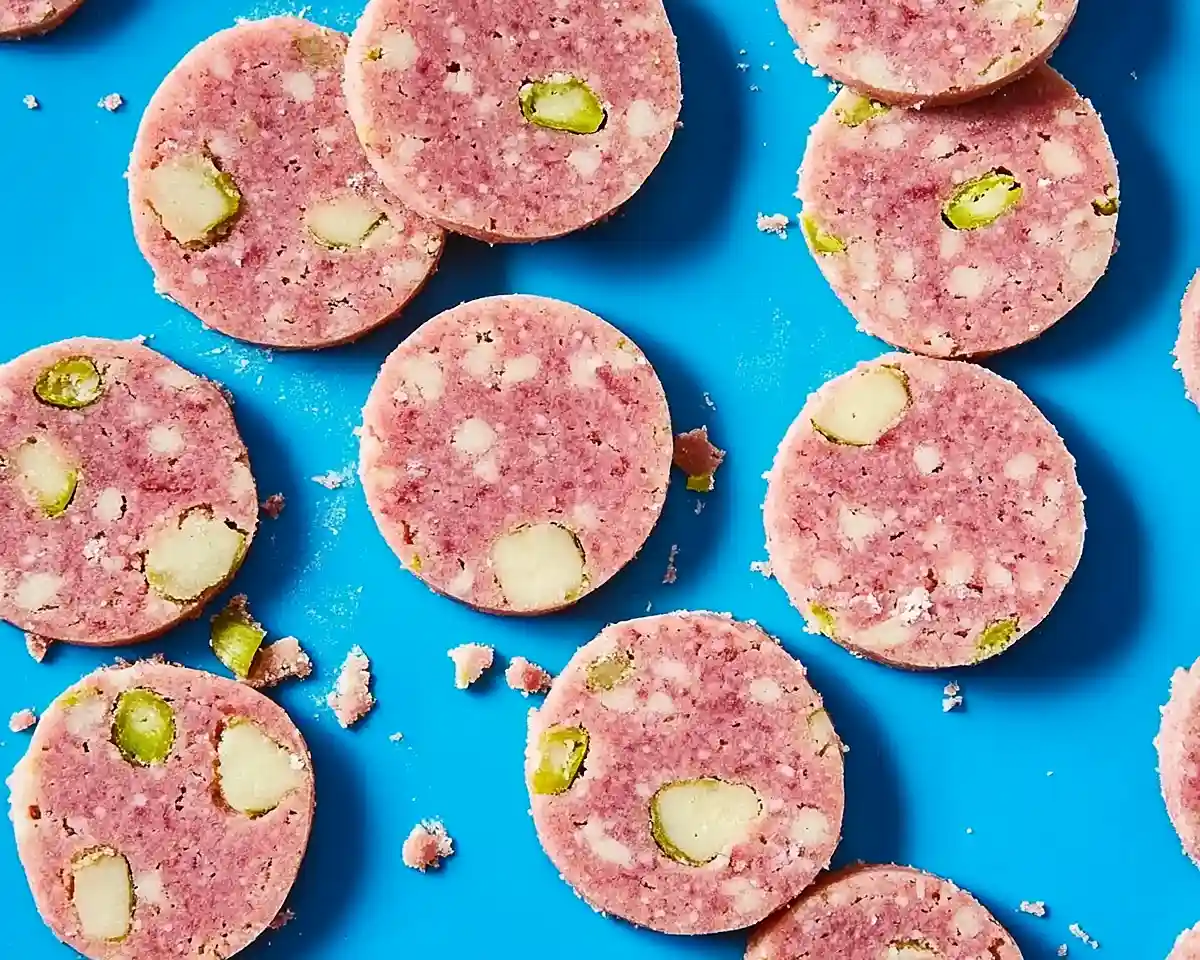
These pink strawberry mortadella cookies look just like Italian sausage slices! Sweet almond dough, crunchy nuts, and a sparkly sugar coating make them irresistible.
What Are Mortadella Cookies?
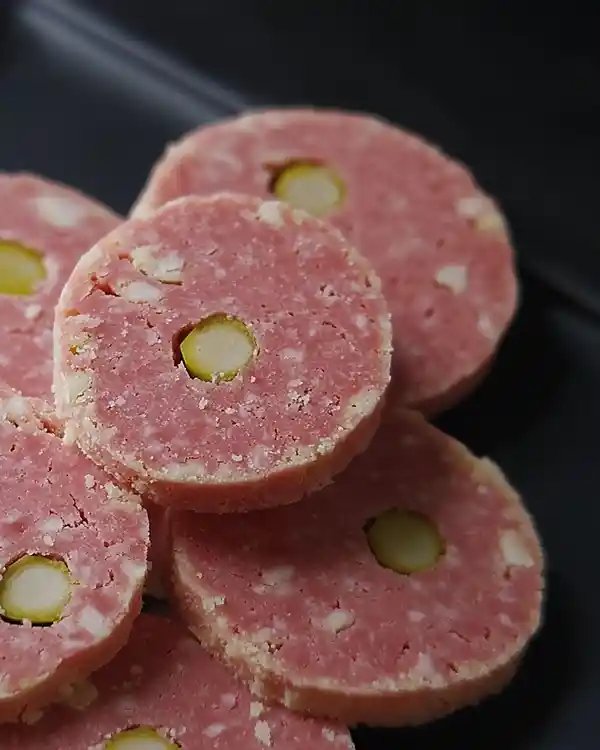
Mortadella cookies are whimsical strawberry almond slice-and-bake cookies studded with macadamia nuts and pistachios that create an uncanny resemblance to Italian mortadella sausage when sliced. The pink freeze-dried strawberry dough, speckled with chopped nuts and coated in sparkling sanding sugar, delivers a buttery, nutty sweetness with subtle almond and berry notes in every tender bite.
I’ll never forget the first time I saw these mortadella cookies at a friend’s holiday party. Everyone kept doing double-takes—are those… salami cookies? The genius is all in the presentation. The pink strawberry-tinted dough mimics mortadella’s characteristic color, while the scattered nuts play the role of fat pockets you’d see in the real Italian sausage.
It’s a delightfully quirky conversation starter that tastes nothing like meat (thank goodness!) and everything like a sophisticated butter cookie. If you’re into playful baking that makes people smile, you’ll also want to check out our marbled sugar cookie twists for another eye-catching treat.
Table of Contents
Why You’ll Love This Mortadella Cookie Recipe
This mortadella cookie recipe wins hearts for so many reasons. First, they’re slice-and-bake, which means you can make the dough days ahead and bake fresh cookies whenever the craving hits. The freeze-dried strawberries give you that gorgeous pink hue without adding moisture that would throw off your dough consistency.
I learned this technique from studying America’s Test Kitchen’s work on incorporating freeze-dried fruit into baked goods. The crunchy macadamias and pistachios aren’t just for show—they add textural contrast that keeps each bite interesting.
These Italian mortadella cookies are surprisingly elegant despite their silly name. The almond paste creates an incredibly tender crumb with a subtle marzipan flavor that pairs beautifully with the berry notes. Plus, that sparkling sanding sugar coating? Pure magic under party lights.
Here’s my favorite part: you can make a double batch, freeze half the dough, and have impressive homemade cookies ready to slice and bake for unexpected guests. I’ve pulled this move more times than I can count, and people always think I spent hours in the kitchen.
If you love clever slice-and-bake recipes, our cranberry pistachio shortbread cookies use the same log-and-slice method with jewel-toned cranberries and pistachios for an equally stunning cookie tin addition.
Mortadella Cookies
Equipment
- fine-mesh strainer
- Bench scraper
- Small bowl
- Cutting board
Ingredients
- ½ cup raw macadamia nuts chopped into ¼-inch pieces (2½ ounces)
- 3 tablespoons raw pistachios chopped into ⅛-inch pieces
- 1¼ cups all-purpose flour 163 grams
- 1½ ounces freeze-dried strawberries about 2 cups
- ½ teaspoon kosher salt Diamond Crystal, or ¼ teaspoon coarse kosher salt (Morton)
- ⅛ teaspoon baking powder
- ½ cup unsalted butter chilled, cut into tablespoon-size pieces (113 grams)
- 4 ounces almond paste cut into tablespoon-size pieces
- ⅔ cup powdered sugar 83 grams
- ¼ teaspoon almond extract
- 1 large egg white divided
- ⅓ cup sanding sugar 60 grams
Instructions
- Toss the chopped macadamia nuts and pistachios together on your cutting board, then transfer them to a small bowl, leaving behind any powdery bits. Those fine pieces can burn easily, so save them for your morning oatmeal instead. Set the nut mixture aside.
- Combine the all-purpose flour, freeze-dried strawberries, kosher salt, and baking powder in your food processor. Pulse for about 45 seconds until the strawberries completely disappear into the flour and you’re left with a uniformly pink mixture. Sift this through a fine-mesh strainer onto a large piece of parchment paper (discard any strawberry chunks that won’t go through). This step ensures no surprise berry bits throw off your cookie texture.
- No need to wash the processor bowl. Add the chilled butter pieces, almond paste chunks, powdered sugar, and almond extract. Process until completely smooth, stopping once to scrape down the sides. In a small bowl, beat the egg white with a fork until slightly foamy, then measure out exactly 1 tablespoon and add it to the processor (save the rest—you’ll need it later). Process until smooth, scrape again, then add all that pink flour mixture. Process for about 20 seconds until a dough ball forms around the blade, scraping halfway through.
- Turn the dough onto your reserved parchment paper and knead briefly to eliminate any streaks. Pat it into a ¾-inch-thick disc, then sprinkle your reserved nuts across the top. Knead until the nuts distribute evenly throughout, then shape the dough into a 10-inch log running lengthwise on the parchment. Roll it gently to smooth the surface, then press any large nut pieces that stick out back into the center, pinching the dough closed around them. This prevents crumbling when you slice later.
- Fold the far end of parchment down over the log, then place your bench scraper on top at a slight downward angle. Push the scraper along the length while pulling back on the parchment. This compresses the dough into a tight, uniform cylinder about 12 inches long and just under 2 inches in diameter. It feels a bit awkward the first time, but it creates those perfect round slices.
- Roll the log snugly in the parchment, then wrap it tightly in two layers of plastic wrap, leaving some overhang on each end. Grab the excess wrapping on both ends and twist firmly, compacting the dough into an even firmer cylinder as you go. Refrigerate for at least 2 hours until cold and firm. This chilling time isn’t optional—it makes slicing so much easier.
- Spread the sanding sugar across your work surface or a cutting board. Unwrap your chilled dough log and brush it all over with the reserved egg white (this is your glue). Roll the log through the sugar, pressing firmly so every sparkly crystal adheres, until the entire surface is coated. Place the sugar-crusted log on a small cutting board and freeze for 15 to 20 minutes until very firm but not frozen solid.
- Heat your oven to 300 degrees. Line a baking sheet with fresh parchment paper.
- Remove the dough from the freezer. Use a sharp knife to trim one end cleanly, then slice the log into ¼-inch-thick rounds. Place them on your prepared baking sheet about ½ inch apart (they spread slightly but not much). As you slice, rotate the log every few cuts to maintain that round shape. If you can’t fit all the slices on one sheet, refrigerate the extras while the first batch bakes.
- Slide your baking sheet onto the center oven rack and bake for 16 to 19 minutes, until the cookies are just barely golden at the edges. They should still look fairly pale in the center. Let them cool on the baking sheet for several minutes—they’ll be quite delicate when hot—then transfer to a wire rack. Repeat with any remaining dough slices.
Notes
Nutrition
This recipe is inspired by Claire Saffitz’s Mortadella Cookies originally published in The New York Times. The method and flavors have been adapted for clarity and home-baker success.
Nutritional Information Per Cookie
| Nutrient | Amount |
|---|---|
| Calories | 145 |
| Protein | 2g |
| Carbohydrates | 16g |
| Fat | 8g |
| Sugar | 10g |
Based on 24 cookies per batch
What You’ll Need for Savory Mortadella Cookies
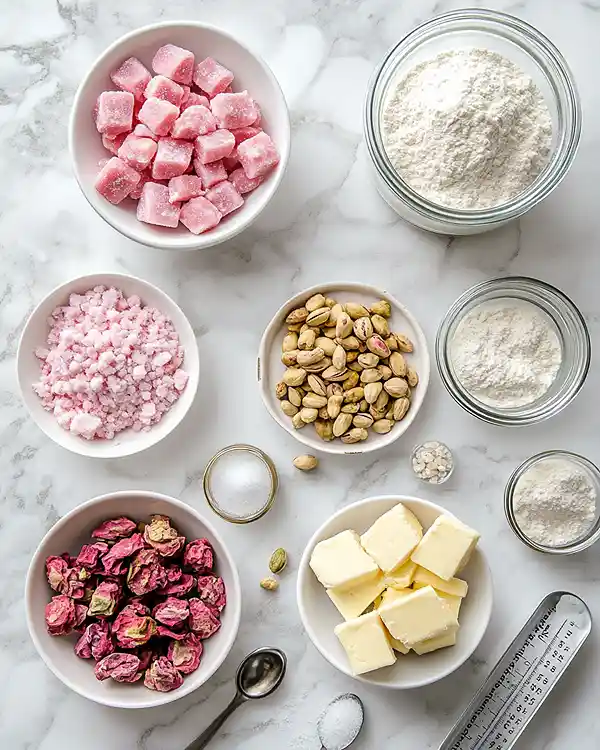
To create these stunning savory mortadella cookies (well, sweet cookies that look savory!), you’ll need a mix of pantry staples and a few special ingredients. The freeze-dried strawberries are worth seeking out—you’ll find them in the dried fruit section or online. For the best results with our kitchen-tested chocolate chip cookies, using quality ingredients makes all the difference.
| Amount | Ingredient | Notes |
|---|---|---|
| ½ cup (2½ oz) | Raw macadamia nuts, chopped into ¼-inch pieces | These create the “fat pockets” that make the mortadella illusion work |
| 3 tablespoons | Raw pistachios, chopped into ⅛-inch pieces | The green flecks add visual authenticity |
| 1¼ cups (163g) | All-purpose flour | I always spoon and level for accuracy |
| 1½ ounces | Freeze-dried strawberries (about 2 cups) | This is your pink color magic |
| ½ teaspoon | Kosher salt (Diamond Crystal) or ¼ teaspoon coarse salt (Morton) | Don’t skip—it balances the sweetness |
| ⅛ teaspoon | Baking powder | Just a touch for structure |
| ½ cup (113g) | Unsalted butter, chilled, cut into tablespoon pieces | Cold butter = better texture |
| 4 ounces | Almond paste, cut into tablespoon pieces | Not marzipan—almond paste has less sugar |
| ⅔ cup (83g) | Powdered sugar | Sifted if lumpy |
| ¼ teaspoon | Almond extract | A little goes a long way |
| 1 | Large egg white, divided | You’ll use it in two steps |
| ⅓ cup (60g) | Sanding sugar | The sparkly finishing touch |
Essential Equipment
You’ll need these tools to nail your mortadella cookies:
- Food processor – Crucial for grinding the strawberries evenly and mixing the dough
- Fine-mesh strainer – Gets rid of any stubborn strawberry bits
- Parchment paper – At least 14 inches long for shaping
- Bench scraper – Makes shaping the log so much easier
- Plastic wrap – For tight wrapping
- Sharp knife – Clean slices make prettier cookies
- Baking sheet and parchment
- Wire cooling rack
Optional but helpful: kitchen scale for precision, pastry brush for egg white application
How to Make Mortadella Cookies Step by Step
Making mortadella cookies is easier than you’d think, though the process takes a little patience. The payoff is absolutely worth it when you slice into that log and see those adorable salami-lookalike rounds!
Step 1: Prepare Your Nuts
Toss the chopped macadamia nuts and pistachios together on your cutting board, then transfer them to a small bowl, leaving behind any powdery bits. Those fine pieces can burn easily, so save them for your morning oatmeal instead. Set the nut mixture aside.
Step 2: Create Your Pink Flour
Combine the all-purpose flour, freeze-dried strawberries, kosher salt, and baking powder in your food processor. Pulse for about 45 seconds until the strawberries completely disappear into the flour and you’re left with a uniformly pink mixture.
Sift this through a fine-mesh strainer onto a large piece of parchment paper (discard any strawberry chunks that won’t go through). This step ensures no surprise berry bits throw off your cookie texture.
Step 3: Make the Dough Base
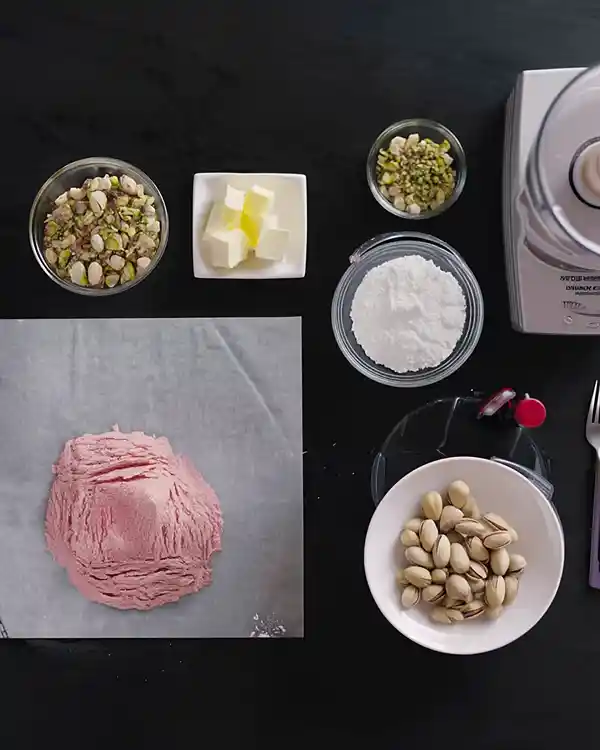
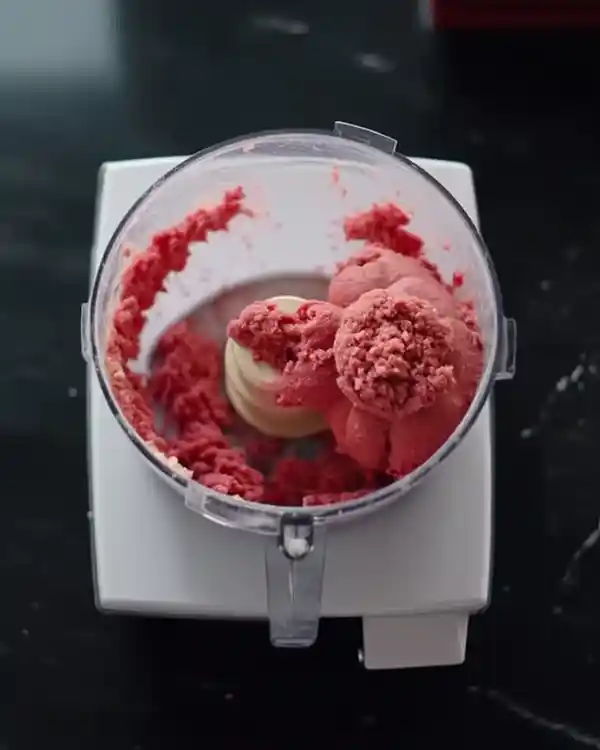
No need to wash the processor bowl. Add the chilled butter pieces, almond paste chunks, powdered sugar, and almond extract. Process until completely smooth, stopping once to scrape down the sides.
In a small bowl, beat the egg white with a fork until slightly foamy, then measure out exactly 1 tablespoon and add it to the processor (save the rest—you’ll need it later). Process until smooth, scrape again, then add all that pink flour mixture. Process for about 20 seconds until a dough ball forms around the blade, scraping halfway through.
Step 4: Incorporate the Nuts
Turn the dough onto your reserved parchment paper and knead briefly to eliminate any streaks. Pat it into a ¾-inch-thick disc, then sprinkle your reserved nuts across the top. Knead until the nuts distribute evenly throughout, then shape the dough into a 10-inch log running lengthwise on the parchment.
Roll it gently to smooth the surface, then press any large nut pieces that stick out back into the center, pinching the dough closed around them. This prevents crumbling when you slice later.
Step 5: Shape Your Log
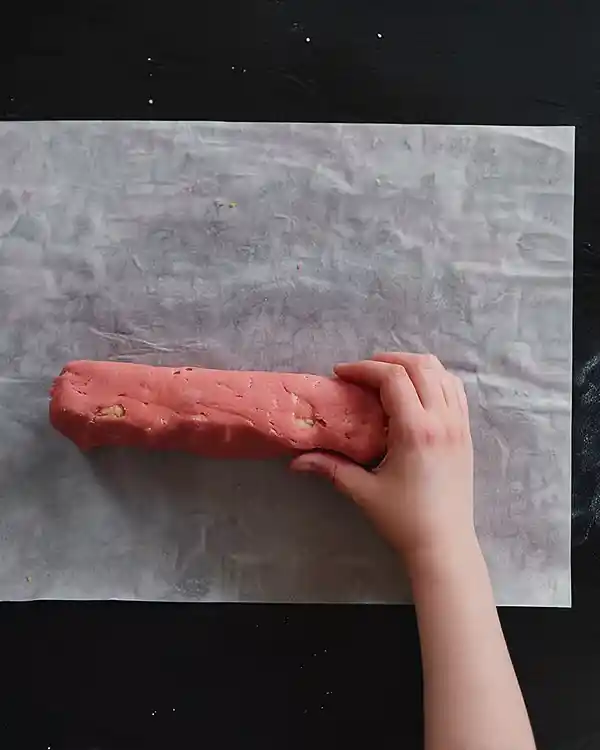
Here’s the trick I learned from Serious Eats’ guide to slice-and-bake cookies: fold the far end of parchment down over the log, then place your bench scraper on top at a slight downward angle. Push the scraper along the length while pulling back on the parchment.
This compresses the dough into a tight, uniform cylinder about 12 inches long and just under 2 inches in diameter. It feels a bit awkward the first time, but it creates those perfect round slices.
Step 6: Chill the Dough
Roll the log snugly in the parchment, then wrap it tightly in two layers of plastic wrap, leaving some overhang on each end. Grab the excess wrapping on both ends and twist firmly, compacting the dough into an even firmer cylinder as you go. Refrigerate for at least 2 hours until cold and firm. This chilling time isn’t optional—it makes slicing so much easier.
For another dough-you-chill-then-slice project, our shortbread cranberry pistachio cookies deliver buttery rounds studded with nuts and fruit using a nearly identical shaping technique.
Step 7: Apply the Sugar Coating
Spread the sanding sugar across your work surface or a cutting board. Unwrap your chilled dough log and brush it all over with the reserved egg white (this is your glue). Roll the log through the sugar, pressing firmly so every sparkly crystal adheres, until the entire surface is coated. Place the sugar-crusted log on a small cutting board and freeze for 15 to 20 minutes until very firm but not frozen solid.
Step 8: Preheat and Prep
Heat your oven to 300 degrees—this lower temperature prevents over-browning. Line a baking sheet with fresh parchment paper.
Step 9: Slice Your Cookies
Remove the dough from the freezer. Use a sharp knife to trim one end cleanly, then slice the log into ¼-inch-thick rounds. Place them on your prepared baking sheet about ½ inch apart (they spread slightly but not much). As you slice, rotate the log every few cuts to maintain that round shape. If you can’t fit all the slices on one sheet, refrigerate the extras while the first batch bakes.
Step 10: Bake to Perfection
Slide your baking sheet onto the center oven rack and bake for 16 to 19 minutes, until the cookies are just barely golden at the edges. They should still look fairly pale in the center. Let them cool on the baking sheet for several minutes—they’ll be quite delicate when hot—then transfer to a wire rack. Repeat with any remaining dough slices.
Pro Tips for Perfect Italian Mortadella Cookies
Your Italian mortadella cookies will turn out best when you pay attention to these details I’ve learned through trial and error.
Keep Everything Cold
Cold ingredients are essential here. According to King Arthur Baking’s guide to butter temperature in cookies, chilled butter creates a more tender crumb because it doesn’t fully incorporate into the flour, leaving tiny pockets that create flakiness. If your kitchen is warm, pop the dough back in the fridge between steps.
Don’t Skip the Sifting
Sifting out those stubborn strawberry bits prevents hard chunks in your cookies. I learned this the hard way when a friend bit into an un-sifted batch and hit a freeze-dried strawberry shard. Not the elegant experience we’re going for!
Want Deeper Pink?
The natural strawberry color is lovely and subtle, but if you want that really vibrant mortadella-pink, add a few drops of red gel food coloring when you make the dough in Step 3. Gel coloring won’t add extra moisture like liquid food coloring does.
Slice with Confidence
A sharp knife makes all the difference. I like to wipe my blade clean every few slices for the neatest edges. If the dough starts to soften and squish instead of slice cleanly, pop it back in the freezer for 5 minutes.
The Bench Scraper Trick
That parchment-and-bench-scraper technique in Step 5 comes from professional pastry kitchens. It creates an incredibly uniform log without the flat spots you get from just rolling by hand. The compression also means your cookies hold together better during slicing.
Why Did My Cookies Turn Out Wrong?
Why are my cookies spreading too much?
Your dough probably wasn’t cold enough when you sliced it. These need to be really firm going into the oven. Next time, make sure you do that final 15-minute freeze before slicing, and refrigerate any slices that wait for the second batch.
What if my strawberry color looks uneven?
You likely didn’t process the flour mixture long enough in Step 2. Give it a full 45 seconds—it seems like a while, but that’s what it takes to completely pulverize the freeze-dried berries. Also make sure you’re sifting out any chunks that won’t break down.
My cookies are crumbly—what happened?
This usually means the nuts weren’t incorporated well enough, or you didn’t compress the log tightly when shaping. Make sure you’re really kneading those nuts in during Step 4, and don’t skip the twisting-compression step when you wrap the log. Those actions pack everything together.
Can I use salted butter instead?
You can, but reduce the added salt to just a pinch. Almond paste already contains some salt, so your cookies could end up too salty otherwise. Unsalted butter gives you better control.
Why won’t the sanding sugar stick?
You need that egg white “glue” brushed all over the log. If your egg white has been sitting around and dried out, beat it lightly with a drop of water to loosen it up. Press firmly as you roll the log through the sugar—gentle rolling won’t cut it.
Fun Variations to Try
Start with the basic mortadella cookie recipe, then make it your own with these twists.
Chocolate Mortadella Cookies
Swap freeze-dried raspberries for the strawberries and add 2 tablespoons of cocoa powder to the flour mixture for a deeper color and subtle chocolate flavor. The raspberry-chocolate combo is heavenly.
Lemon-Pistachio Version
Replace the almond extract with lemon extract and add 1 teaspoon of lemon zest to the dough. Skip the macadamias and use all pistachios for a gorgeous green-speckled cookie. Check out our lemon butter cookies for more citrus inspiration.
Holiday Peppermint Style
Use freeze-dried raspberries for a deeper pink, add ¼ teaspoon peppermint extract instead of almond, and toss in some crushed candy cane pieces with the nuts. Very festive!
Go Gluten-Free
For a dedicated gluten-free version with specific flour blend recommendations and technique adjustments, we’ve created a comprehensive gluten-free slice-and-bake cookie guide that covers all the details.
How Should I Serve and Store These?
Serving Suggestions
These mortadella cookies shine on a dessert platter alongside other Italian-inspired treats. I love serving them with espresso or a sweet dessert wine like Vin Santo. Their compact size makes them perfect for cookie exchanges or gift boxes—just stack them carefully with parchment between layers.
For maximum visual impact, arrange them on a wooden board with some real mortadella nearby (seriously—the side-by-side comparison always gets laughs). They’re also adorable tucked into clear cellophane bags tied with baker’s twine.
Storage Tips
Store baked cookies in an airtight container at room temperature for up to 5 days. They’ll soften slightly over time, but that just makes them more tender. If you like a crisper cookie, eat them within the first 2 days.
Can You Freeze These?
Absolutely! The unbaked dough log can be refrigerated for up to 3 days or frozen for up to 2 months. If freezing, wrap it extra well in plastic wrap and aluminum foil. When you’re ready to bake, thaw the log overnight in the refrigerator, then coat with sanding sugar and proceed with slicing and baking. Don’t coat the log with sugar before freezing—apply it fresh before slicing.
If these mortadella-lookalike cookies have you craving more Italian-inspired sweets, our pistachio ricotta cake is a moist, nutty loaf with classic Italian café vibes.
Zero-Waste Kitchen Ideas
Use Those Nut Bits
Remember those powdery nut pieces you left on the cutting board in Step 1? Stir them into yogurt, sprinkle over oatmeal, or fold into pancake batter. They’re too precious to toss!
Leftover Egg Yolk
You’ve got a whole egg yolk sitting around after using just the white. Brush it over pie crusts for shine, whisk it into scrambled eggs, or make a quick custard. I often save 3-4 yolks in the fridge and make a small batch of lemon curd.
Extra Almond Paste
If you bought a larger package of almond paste, freeze what you don’t use. It keeps for months and you can grate it frozen into cookie dough, use it in croissant filling, or blend it into smoothies for extra richness.
Freeze-Dried Strawberry Dust
Any fine strawberry powder that didn’t make it through the sifter? Save it in a small jar to dust over frosted cakes, stir into white chocolate, or sprinkle over ice cream. It’s like natural strawberry magic dust.
Your Mortadella Cookie Questions Answered
Can I make mortadella cookies ahead of time for a party?
Yes! These are ideal make-ahead cookies. Shape the dough log, wrap it tightly, and refrigerate for up to 3 days or freeze for up to 2 months. Just remember to apply the sanding sugar coating right before you slice and bake. You can even bake the cookies 2 days ahead and store them in an airtight container.
What’s the best substitute for almond paste in this recipe?
You can use marzipan in a pinch, though it’s sweeter and has a finer texture than almond paste. Reduce the powdered sugar by 2 tablespoons if using marzipan. There isn’t a great non-almond substitute since the almond paste provides both flavor and texture structure, but very finely ground almonds mixed with a bit of powdered sugar (about 3:1 ratio) works in a pinch.
Why do mortadella cookies need such a low baking temperature?
The 300-degree temperature prevents the delicate pink color from browning too quickly. At higher temperatures, the edges would darken before the centers bake through, and you’d lose that beautiful pale-pink mortadella look. Low and slow keeps them tender and preserves the color.
Can I use regular dried strawberries instead of freeze-dried?
Unfortunately no—regular dried strawberries contain too much moisture and won’t grind into a fine powder. They’ll create gummy chunks in your dough and potentially make it too wet. Freeze-dried strawberries are shelf-stable and pulverize into that perfect pink flour. Look for them in the dried fruit aisle or order online.
How do I keep my cookie dough log perfectly round when slicing?
The key is rotating the log every 3-4 slices. If you just keep slicing from one side, gravity will flatten the bottom. Giving it a quarter turn regularly maintains that circular shape. Also make sure the dough is very firm—if it’s too soft, it’ll squish when you cut. A quick 5-minute freeze refreshes firmness if needed.
What makes these look like mortadella sausage specifically?
It’s the combination of pink dough (mimicking the cured meat color), the white and green nut pieces scattered throughout (representing the fat pockets and pistachios in real mortadella), and the white sugar coating around the edge (like the casing). When sliced into rounds, the resemblance is uncanny!
Time to Make Your Own Mortadella Magic
These mortadella cookies never fail to bring smiles and spark conversations. Whether you’re baking them for a holiday party, an Italian-themed dinner, or just because you want something whimsical in your cookie jar, they deliver on both looks and flavor.
I’d love to see your mortadella cookie creations! Share your photos in the comments below and let me know if you tried any fun variations. And if you’re in a slice-and-bake mood, don’t miss our classic vanilla slice-and-bake cookies for another easy refrigerator cookie option.
Happy baking!
Baked with love by Rebeccah Ellene



do you ever feel guilty for your actions?
Not sure what you mean, but I hope you enjoyed the recipe! 😊
I know…its really despicable! I can’t believe she didn’t credit Claire Saffitz!
Thanks for pointing that out! This recipe is inspired by Claire Saffitz’s mortadella cookies originally published in The New York Times, and I’ve added proper credit to the post. I appreciate you taking the time to comment.
I think they mean this recipe belongs to Claire Saffitz, who’s recipe was posted in the NYT a few weeks ago. Give credit where credit is due.
Thanks for pointing that out! This recipe is inspired by Claire Saffitz’s mortadella cookies originally published in The New York Times, and I’ve added proper credit to the post. I appreciate you taking the time to comment.
Stolen
Thanks for pointing that out! This recipe is inspired by Claire Saffitz’s mortadella cookies originally published in The New York Times, and I’ve added proper credit to the post. I appreciate you taking the time to comment.
A tricky recipe but worth it in the end! I actually really appreciated a recipe that isn’t behind a paywall like everything else in this economy 🤪 it’s been a tough year and I find a lot of enjoyment in trying out interesting cookie recipes (plus Claire what’s-her-butt has plenty of kudos already lol)Thanks for putting this together and thanks for the comprehensive tips! I made a few alterations(king Arthur gf flour blend instead of regular for my celiac partner) but overall I really like the flavors and textures. I’ll definitely be making these again!